Measuring an Error Rate, Defensibly
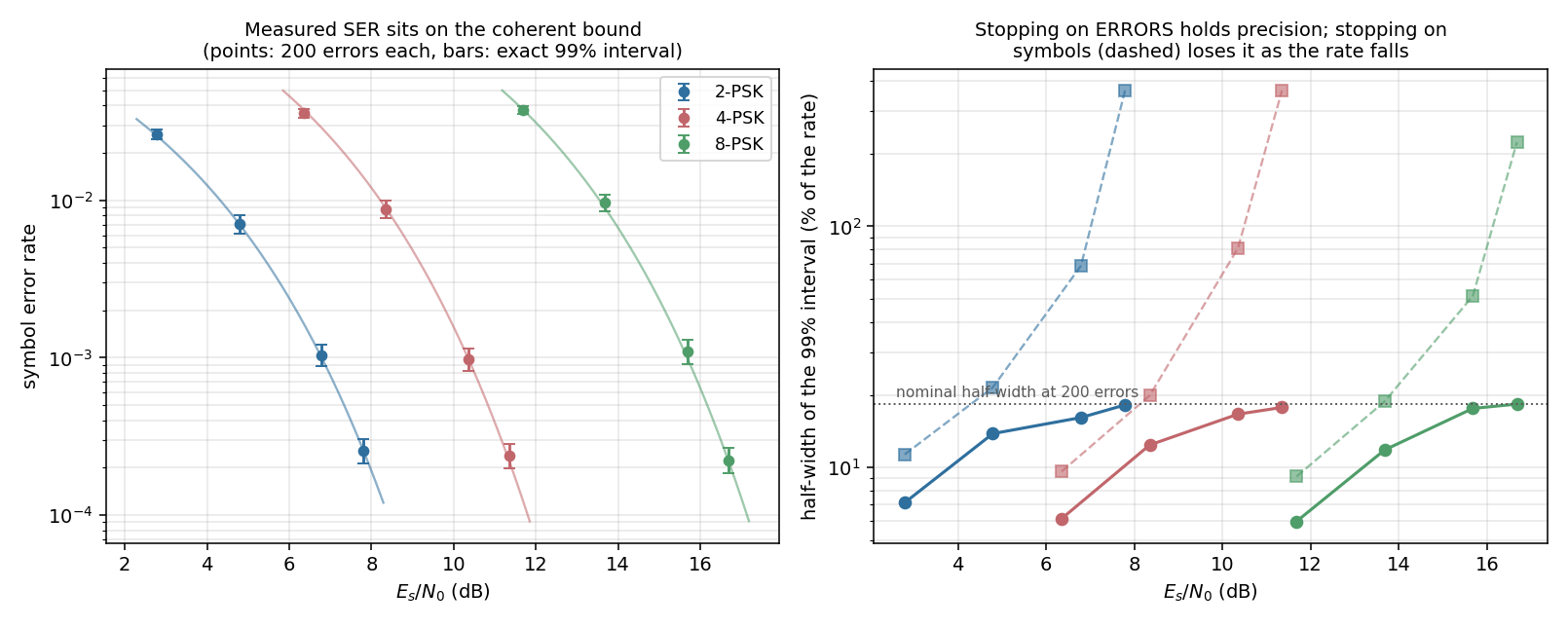
An error rate is a measurement, and like any measurement it can be
confidently wrong. This example puts ber.BerMeter on an ideal AWGN channel
with no receiver in the loop, so what is on trial is the instrument rather
than a demodulator: unit-energy M-PSK symbols, source.AWGN, and nothing in
between that could excuse a bad number.
What you're seeing
Left — the measurement lands on the bound. Each point is a run stopped
after 200 symbol errors, with the exact 99% confidence interval drawn as a
bar, against the coherent M-PSK bound (ber.ber_theory_ser). An ideal channel
has no implementation loss, so the interval must contain the bound. The
script asserts exactly that at all twelve points — if it ever fails, the
measurement is wrong, not the channel.
Right — why stopping on errors is the whole point. Both curves measure the same streams; only the stopping rule differs. Stop after a fixed 200 errors (solid) and the interval half-width stays pinned at or below its nominal 18.3% at every rate. Stop after a fixed 20 000 symbols (dashed) and precision collapses as the rate falls — past 400% of the rate at the high-SNR end, where the run catches a handful of errors and the interval spans an order of magnitude.
That divergence is the trap. A fixed-symbol sweep does not announce that it has run out of resolution; it just returns numbers that scatter more and more, and the scatter reads as real variation in whatever is under test. This project misread exactly that once: 20 000 symbols at a SER of 1e-3 yields ~20 errors and ~22% relative error, which looked like seed-to-seed variation in a receiver and was not.
Under inverse binomial sampling — fix the errors r, let the symbol count N
be the random variable — the relative standard error is 1/sqrt(r), a function
of the error count alone. The error target is the precision, chosen up
front and independent of the rate you are about to measure. (The solid points
sit below the line at high SER only because a 50 000-symbol block overshoots
the 200-error target before the loop next checks; the target bounds the width,
it does not pin it.)
How it works
The transmitted stream is rolled by an unknown lag and spun by an unknown
phase, and align() has to recover both on its own. It does that by
detecting the alignment — correlating a known marker (here a stretch of the
truth sequence) and gating the peak on a false-alarm probability — rather than
searching for the lag and rotation that minimise the error count.
That distinction is not pedantic. A min over (lag, rotation) search is an
optimisation over the answer: it can find a lucky low-error alignment on
garbage, and it can miss the true alignment on a perfectly healthy stream and
report chance. Both have happened here. align() returns False when the
marker cannot identify an alignment, and the symbols that fixed the alignment
are excluded from scoring so they cannot also flatter the rate.
def measure(m, esn0_db, target_errors=200, max_symbols=8_000_000, seed=1):
    """Symbol error rate at `esn0_db`, stopping on ERRORS not symbols.

    Es/N0 is set at the symbol: unit-energy M-PSK points plus complex AWGN of
    per-quadrature variance `sigma^2`, so `Es/N0 = 1/(2 sigma^2)`.

    The transmitted stream is rolled by an unknown lag and spun by an unknown
    phase, both of which `align()` must recover on its own. That is the point:
    it DETECTS the alignment by correlating a known marker under a false-alarm
    gate, rather than searching for the lag and rotation that minimise the
    error count. A search would be an optimisation over the answer -- it can
    find a lucky alignment on garbage, and it can miss the true one on a
    healthy stream and report chance.
    """
    rng = np.random.default_rng(seed)
    lag, phase = 9, 0.7  # unknown to the meter
    # The amplitude comes from the library's own law rather than a
    # transcription. At sps = 1 there is no pulse and no oversampling, so
    # Es/N0 and the per-sample SNR are the SAME number -- which is why one
    # call with unit signal power serves an Es/N0 axis here and would not in
    # an oversampled demo. `sqrt(0.5 / 10**(esn0/10))` said that implicitly,
    # in an expression where the 0.5 is the I/Q split and nothing names the
    # sps = 1 assumption at all.
    noise = AWGN(seed=seed, amplitude=wfm_awgn_amplitude(esn0_db, 1.0))
    meter = BerMeter(m=m, target_errors=target_errors, conf=0.99)

    while not meter.enough and meter.symbols < max_symbols:
        truth = rng.integers(0, m, 50_000).astype(np.uint8)
        phi0 = np.pi / 4 if m == 4 else 0.0
        clean = np.exp(1j * (2 * np.pi * truth / m + phi0 + phase))
        rx = (np.roll(clean, -lag) + noise.generate(truth.size)).astype(
            np.complex64
        )

        meter.set_truth(truth)
        if not meter.align(rx, t0=300, n_marker=256):
            continue  # no detection -> contribute nothing, never a guess
        # Score only AFTER the marker: the symbols that fixed the alignment
        # must not also be scored, or they flatter the rate.
        meter.score(rx, lo=300 + 256 - meter.lag, hi=truth.size)

    return meter.ser()
BerMeter.ser() and .ber() return a BerInterval record — p_hat, lo,
hi, rel, conf, errors, symbols. Assert on lo, never on p_hat:
comparing the interval's lower limit against a spec is the form that cannot
flake on counting noise. The interval is the exact Gamma/chi-square one, with
its quantiles taken from detection.det_threshold_noncoherent — doppler's own
inverse regularized incomplete gamma — rather than a normal approximation, so
it stays honest down to a single error.
The same instrument backs the C-side receiver validators
(native/validation/mpsk_receiver_ber.c and its real-IF twin), which is what
keeps a Python sweep and a CI gate measuring the same thing.