M-PSK constellation (Gray-coded map / demap)¶
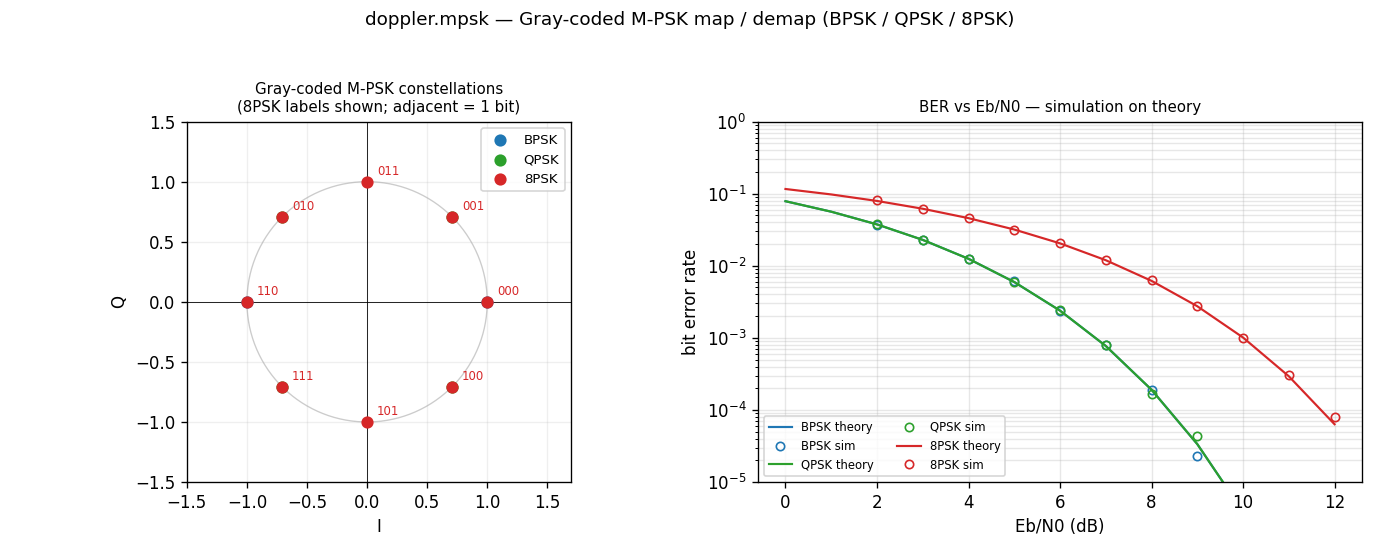
doppler.mpsk is the M-ary PSK constellation
primitive — the decision (and its transmit inverse) the MPSK receiver
composes. A symbol carries log2(M) bits packed into one byte (0..M−1); that
byte is the Gray-coded label, so a slip to an adjacent constellation point
flips exactly one bit. M ∈ {2, 4, 8}: BPSK, QPSK (axis-separable, at π/4), 8PSK.
What you're seeing¶
Left — constellations. BPSK / QPSK / 8PSK on the unit circle (8PSK labels annotated). Walking the circle, each neighbour differs by exactly one bit — the Gray property that makes a symbol error cost (usually) one bit error.
Right — BER vs Eb/N0. mpsk_map → complex AWGN → hard mpsk_demap,
Monte-Carlo, overlaid on the closed forms: BPSK = Gray QPSK = Q(√(2·Eb/N0));
8PSK Gray ≈ (2/3)·Q(√(2·Es/N0)·sin(π/8)). The simulated points sit on the
theory — the constellation and the slicer are correct end to end.
API¶
Element-wise (memoryless) map/demap, plus differential variants. m defaults to
QPSK and is keyword-capable — call positionally or by name:
import numpy as np
from doppler.mpsk import mpsk_map, mpsk_demap, mpsk_bits_per_symbol

sym = np.random.randint(0, 8, 1000).astype(np.uint8)  # 8PSK Gray labels
iq  = mpsk_map(sym, m=8)          # -> unit-amplitude cf32 points
rx  = mpsk_demap(iq, m=8)         # -> Gray labels (hard decision)
assert np.array_equal(rx, sym)
mpsk_bits_per_symbol(8)           # 3
Differential mode resolves the M-fold carrier phase ambiguity (a decision-directed carrier loop locks to one of M phases). Information rides on phase differences, so an unknown constant rotation cancels — and any constant rotation cancels, not merely the M constellation steps, because a constant offset shifts every sliced index equally.
The cost is up to 2× the symbol-error rate, which is a high-SNR asymptote rather than a flat factor. Measured, BPSK and QPSK reach it by ~8 dB Es/N0 while 8PSK — the case below — pays only 1.44× at 4 dB and 2.03× by 14 dB, so a link sized at low Es/N0 is charged less than the round number suggests (validation report, design §9.5):
from doppler.mpsk import mpsk_diff_map, mpsk_diff_demap

iq  = mpsk_diff_map(sym, m=8)
rot = (iq * np.exp(1j * np.pi / 4)).astype(np.complex64)  # one-step phase slip
out = mpsk_diff_demap(rot, m=8)
assert np.array_equal(out[1:], sym[1:])   # rotation-invariant after the reference
How it works¶
map takes the Gray label g, recovers the constellation index k = gray_decode(g), and emits exp(j·(2πk/M + φ0)). demap slices to the nearest
index by phase and returns gray_encode(k̂). The inline mpsk_slice() /
mpsk_constellation() helpers in mpsk_core.h are the C composition API the
carrier loop (track.Carrier.Mpsk) and the MPSK receiver inline per symbol —
the decision-directed carrier error is Im(y · conj(â)) where â is the sliced
point. Differential map/demap accumulate / difference the index across the array.
Source: src/doppler/examples/mpsk_constellation_demo.py.