NDA Carrier Loop — Theory Validation¶
track.CarrierNda is the non-data-aided (NDA)
carrier-recovery loop — the cold-start counterpart to the decision-directed
CarrierMpsk. Per sample it de-rotates with the integer
lo NCO; it filters the de-rotated samples through a free-running I/Q boxcar
moving average of sps/n samples (one output per input sample — no rate
change), and on every sample runs an M-th-power phase discriminator.
Raising the arm sample to the Mth power strips the M-PSK data, so
the loop locks with no symbol timing and no data present — a bare carrier, or
a modulated carrier before timing settles. It is the robust acquisition aid the
MPSK receiver hands over from (see the design note).
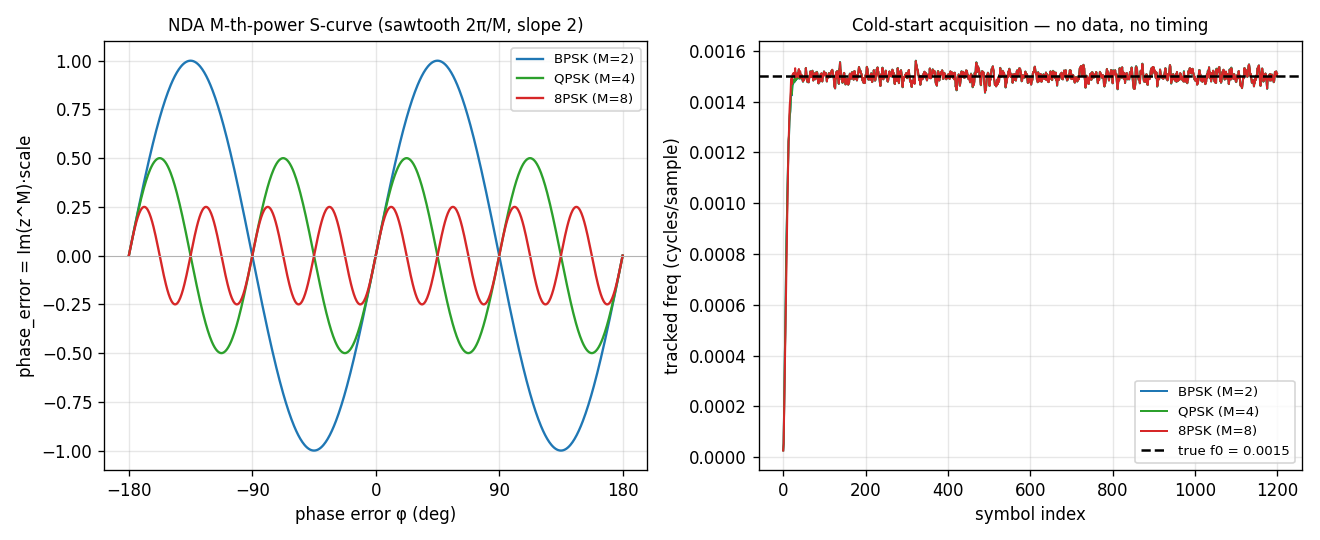
Left — Discriminator S-curve. Driving the discriminator open-loop traces the
scaled M-th-power detector phase_error = Im(z^M)·{1, ½, ¼} for M = 2 / 4 / 8: a
sawtooth of period 2π/M (the M-fold phase ambiguity). The {1, ½, ¼} scale is
not cosmetic — it makes the S-curve slope at lock equal 2 for every M, so one
loop bn behaves identically across BPSK / QPSK / 8PSK. The measured curve
matches the analytic M-th power to ~9e-8. The lock signal (not plotted) is
Re((z/|z|)^M) — the M-th power of a limited sample, so it is bounded in ±1
and its H0 variance is exactly 1/2 at every M. It reads ≈ 1.0 at lock, and that
M-independence is what lets one threshold mean one false-alarm probability at
every order (σ after the EMA is 0.1132, so the default 0.5 is 4.42 σ, a
per-look Pfa of 5e-6). Its EMA is the carrier lock metric that drives handover;
the derivation is on the receiver page.
Right — Cold-start acquisition. A carrier step f0 = 0.0015 cycles/sample on
an unmodulated carrier (no data, no timing): the tracked frequency snaps onto
the truth (black dashed) for all three orders. Because the M-th power is
data-blind it acquires modulated data with no timing just as well (validated in
the tests).
Computation — repeated squaring¶
The M-th power is built by repeatedly squaring the arm sample z = i + jq —
driven to unit average power by an internal AGC so the loop gain is
amplitude-invariant: z² strips BPSK, z⁴ QPSK, z⁸ 8PSK. Each level yields a
phase error and a lock signal at one complex multiply — no atan2, no pow. The
discriminator is the raw M-th-power form (best squaring loss for
constant-modulus signals like DSSS), not a per-sample magnitude limiter. See
docs/design/mpsk.md §2.3 for the derivation and the
squaring-loss equations.
import numpy as np

from doppler.mpsk import mpsk_map
from doppler.track import CarrierNda

# A QPSK signal at 8 samples/symbol carrying a residual carrier offset.
F0 = 0.0015  # residual carrier, cycles/sample
rng = np.random.default_rng(0)
labels = rng.integers(0, 4, 2000).astype(np.uint8)
tx = np.repeat(mpsk_map(labels, 4), 8).astype(np.complex64)
k = np.arange(tx.size)
rx = (tx * np.exp(2j * np.pi * F0 * k)).astype(np.complex64)

# QPSK NDA loop: 8 samples/symbol, sps/n = 2-sample boxcar arm; cold
# start — no data aiding and no symbol timing needed to lock.
c = CarrierNda(bn=0.01, zeta=0.707, init_norm_freq=0.0, sps=8, n=4, m=4)
derot = c.steps(rx)  # de-rotated samples (one per input sample)
f_est = c.norm_freq  # tracked carrier (cycles/sample)
locked = c.lock  # M-th-power lock metric (normalised: -> ~1 when locked)
Rigorous bounds¶
The C harnesses native/validation/carrier_nda_scurve.c,
carrier_nda_pullin.c, and carrier_nda_step_response.c (ctest --check)
prove: phase_error = Im(z^M)·{1,½,¼} and slope 2 for all M (to ~1e-7);
lock_signal = Re((z/|z|)^M), ≈ 1.0 at lock; cold-start frequency pull-in on an
unmodulated carrier per M; lock on modulated M-PSK data with no symbol
timing; closed-loop frequency jitter that grows with bn; and a closed-loop
step response that locks on both constant-modulus and pulse-shaped (RRC) inputs.
Source: src/doppler/examples/mpsk_nda_theory_demo.py; tests in
src/doppler/track/tests/test_theory_carrier_nda.py and the C harnesses above.