DLL Code Loop — Theory Validation
A theoretical-correctness check on track.Dll's
prompt-normalized early-minus-late power code discriminator
0.5·(|E|²-|L|²)/|P|² (clamped to ±1).
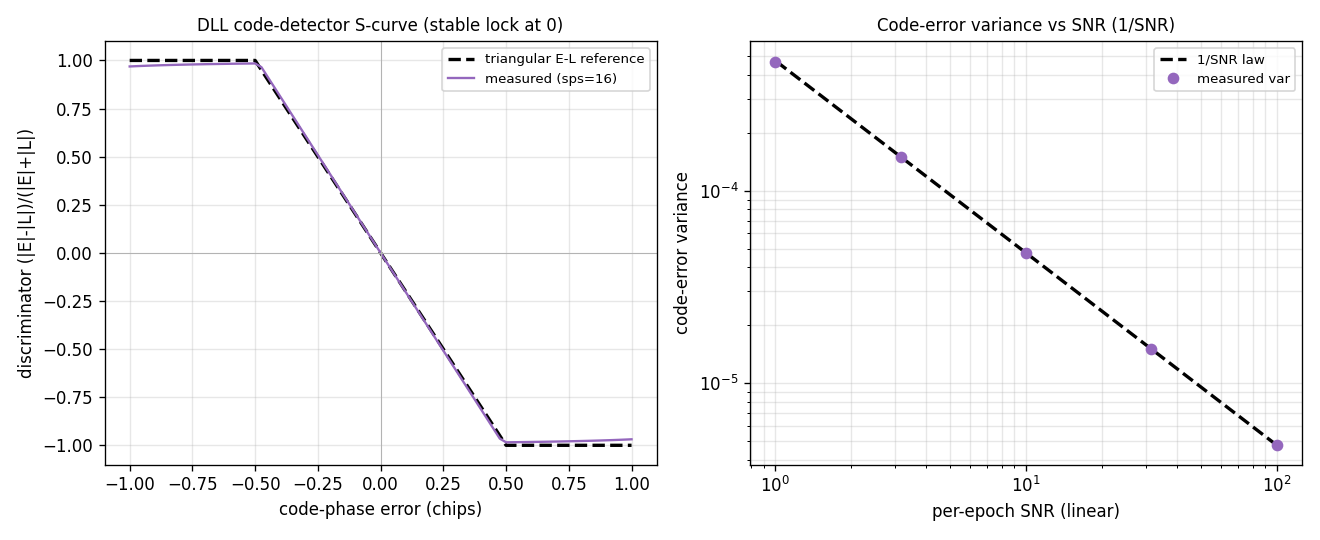
Left — Code-detector S-curve. The open-loop discriminator (swept static
code-phase error, bn → 0) follows the reference built from the triangular code
autocorrelation R(τ)=max(0,1-|τ|),
clip(0.5·(R(τ+s)²-R(τ-s)²)/R(τ)², -1, 1): zero with a restoring (negative)
slope at the lock, and saturating at ±1 by the half-chip point. The
fractional-boundary integrate-and-dump overlap-weights the lone sample
straddling each chip transition, so the curve is smooth and antisymmetric to
round-off at any sps — no integer-sample code-phase staircase, giving the
loop true sub-chip resolution. (The only visible gap between measured and
reference is at the clamp knee, where the continuous triangular model departs
most from the discrete, fractional-boundary-weighted correlation.)
Right — Code-error variance vs SNR. At the lock the early-late discriminator
variance follows a clean 1/SNR law (the per-epoch code-error noise) — the
measurements lie on the line across four decades of SNR.
This completes the three tracking loops' theory validation: the Costas carrier loop, the Gardner timing loop, and the DLL code loop.
Source: src/doppler/examples/dll_theory_demo.py;
tests in src/doppler/track/tests/test_theory_dll.py.