Telemetry: Many Emitters, One Consumer
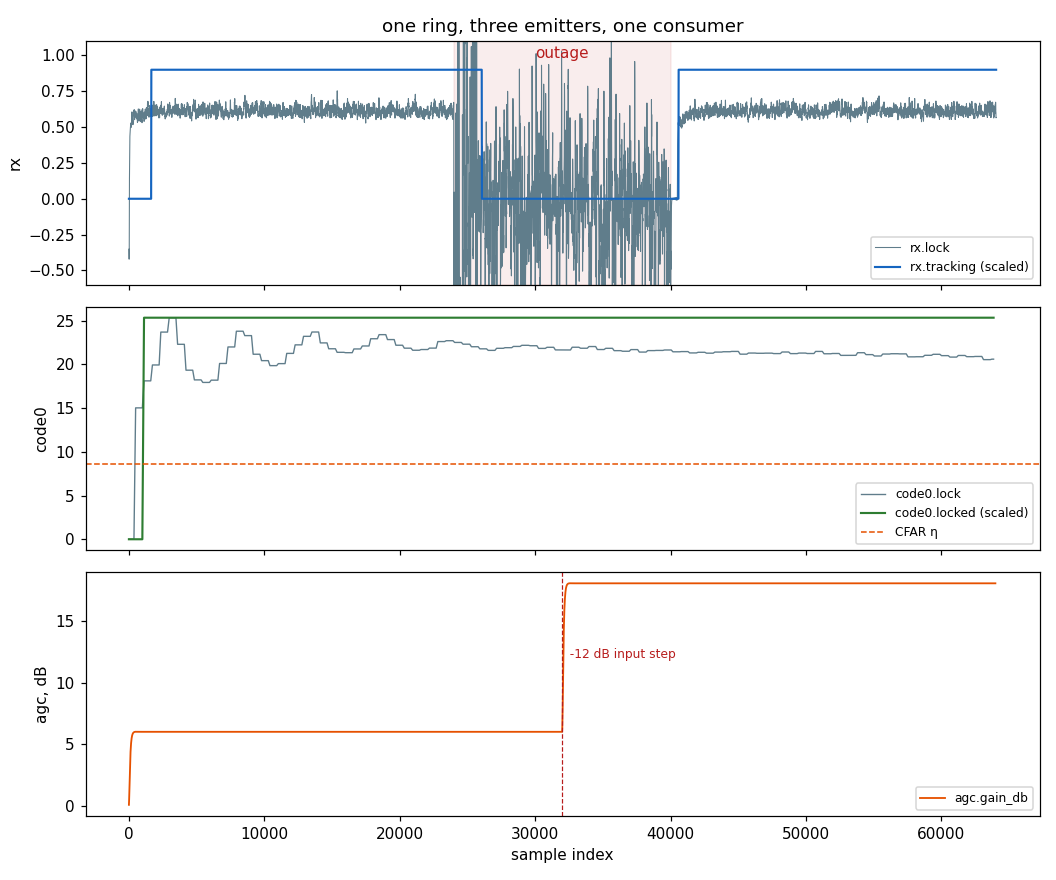
What you're seeing
Three unrelated DSP objects — an M-PSK receiver (rx.*), a DSSS code
loop (code0.*), and an AGC (agc.*) — attached to a single
Telemetry context and stepped block by block on one producer thread,
while one consumer drains the shared ring, demuxes by probe name,
and writes the capture to disk. Every trace in the figure came out of
the same read() loop:
rx— QPSK with a mid-stream outage: the carrier lock EMA (rx.lock) collapses, the two-way handover (rx.tracking) drops back to NDA acquisition, and re-declares when the signal returns.code0— a PN-31 code seeded half a chip off: the CFAR statistic (code0.lock) climbs through pull-in past the dashed detection threshold, and the verify-counted decision (code0.locked) declares once — no chatter at the crossing.agc— a −12 dB input level step:agc.gain_dbramps to re-level the output.
Statistic and decision stream side by side (.lock/.locked,
.lock/.tracking) — the consumer never re-derives a threshold.
The consumption model
Two rules carry the whole design:
- One producer thread per context. The ring is SPSC, so any
number of emitters may share a context as long as everything that
steps does so on one thread — prefixes keep the probe names
disjoint, and
set_now(n)stamps all sources with one sample clock. Multiple threads or processes get a ring each; the fan-in then happens over the wire (below) or in files. - The consumer sets the drain cadence.
read()is non-blocking and the ring never stalls the DSP thread — a slow reader costs records (droppedcounts them), never throughput. Drain at least as fast as the aggregate emit rate anddroppedstays 0.
Write to disk
The 16-byte record layout is the capture format — a structured array saved verbatim, no transformation on either side:
import tempfile
from pathlib import Path

import numpy as np

from doppler.agc import AGC
from doppler.telemetry import Telemetry
from doppler.track import Dll

tlm = Telemetry(1 << 14)  # ONE ring ...
code = (np.arange(31) % 2).astype(np.uint8)
d = Dll(code=code, sps=2)
d.set_telemetry(tlm, "code0")  # ... TWO emitters
agc = AGC(ref_db=0.0, loop_bw=0.0025, alpha=0.05)
agc.set_telemetry(tlm, "agc")

x = np.ones(31 * 2 * 50, dtype=np.complex64)
chunks = []
for i in range(0, x.size, 512):  # produce block-wise ...
    tlm.set_now(i)
    d.steps(x[i : i + 512])
    agc.steps(x[i : i + 512])
    chunks.append(tlm.read())  # ... ONE consumer drains
recs = np.concatenate(chunks)
assert tlm.dropped == 0

cap = Path(tempfile.mkdtemp()) / "tlm_capture.npy"
np.save(cap, recs)  # the record layout IS the file format
back = np.load(cap)
assert np.array_equal(back, recs)

# demux by probe id, e.g. the code loop's verify-counted decision:
locked = back[back["probe"] == tlm.probe_id("code0.locked")]["value"]
assert locked.size > 0
For long captures, append read() chunks to an open file handle and
rotate on size — each chunk is already wire-format bytes.
Subscribe to a service
Across processes the same records travel as TLM16 frames on the NATS
wire layer, and the pattern is subject-is-the-source: each pipeline
drains its own ring to its own subject, and a single consumer
process takes them all in. Probe-id spaces are per-ring, so the subject
tells the consumer which name map to demux with:
from doppler.stream import Publisher, Subscriber, TLM16

# pipeline A and pipeline B (separate processes, one ring each) ...
pub_rx = Publisher("nats://127.0.0.1:4222/tlm.rx0", TLM16)
pub_ch = Publisher("nats://127.0.0.1:4222/tlm.ch1", TLM16)
pub_rx.send(tlm_rx.read())  # each drains its OWN ring, verbatim
pub_ch.send(tlm_ch.read())

# ... and ONE consumer process taking it all in
sources = {
    "rx0": Subscriber("nats://127.0.0.1:4222/tlm.rx0"),
    "ch1": Subscriber("nats://127.0.0.1:4222/tlm.ch1"),
}
for src, sub in sources.items():
    recs, hdr = sub.recv(timeout_ms=1000)
    assert hdr["sample_type"] == TLM16
    print(src, len(recs), "records")  # demux with THAT source's name map
A C pipeline publishes the same frames without Python in the loop: the
dp_tlm_sink_* helper (stream/tlm_sink.h, in the optional
libdoppler_stream component) drains a dp_tlm_t ring straight to a
subject on a timer thread. Frames are byte-identical either way, so C
producers and Python consumers mix freely.
Run it
See the telemetry API for the probe
tables and record layout, Lock Detection for the
verify-counted decisions the rx.tracking / code0.locked traces come
from, and Streaming for the NATS wire layer
itself.