AWGN Generator
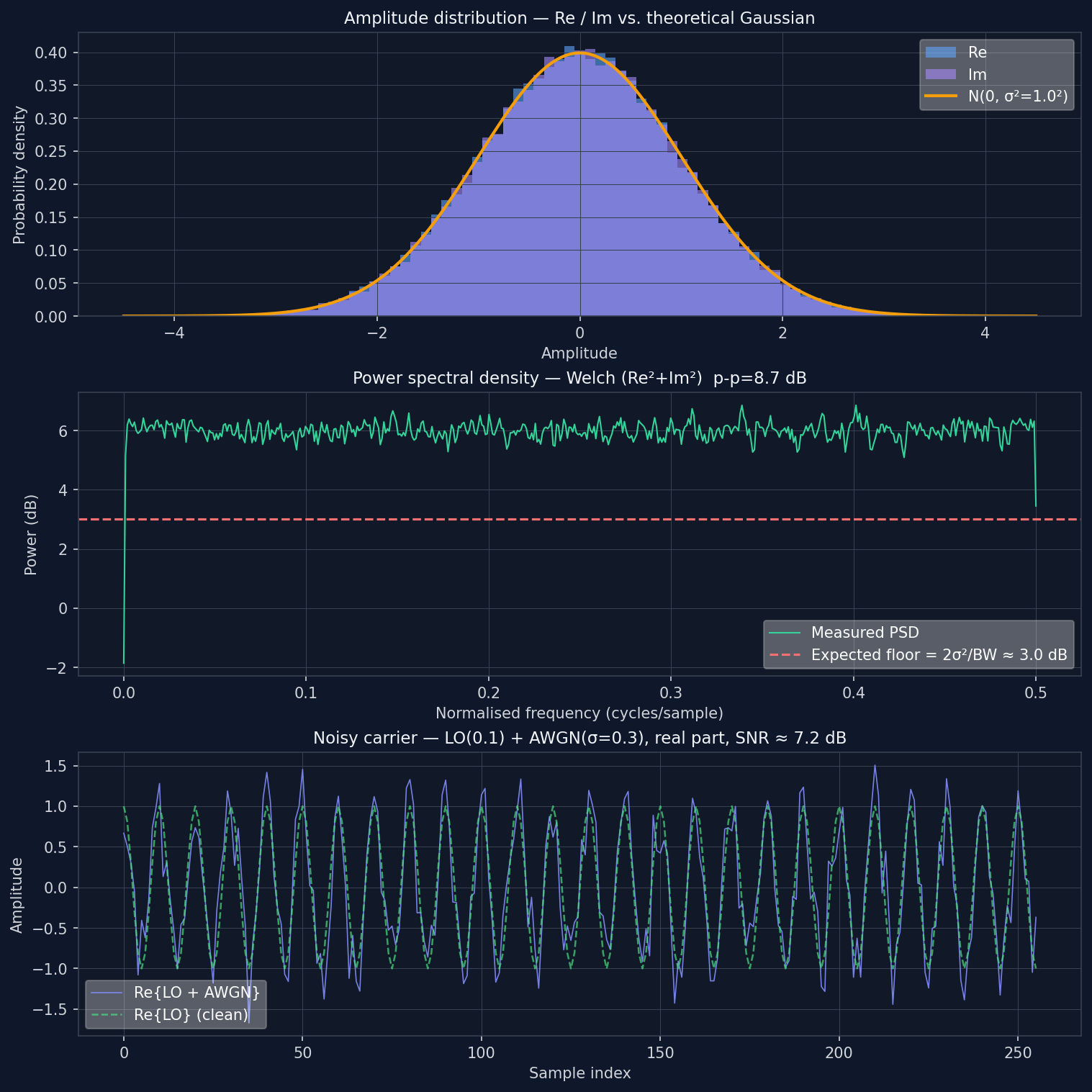
What you're seeing
Top panel — amplitude histogram. Real and imaginary components of 65 536
CF32 samples with amplitude=1.0 overlaid with the theoretical
N(0, σ²=1) Gaussian PDF. Both components track the curve to within
statistical noise, confirming the Box-Muller transform is unbiased.
Middle panel — Welch PSD. One-sided power spectral density of
65 536 samples (Re²+Im², nperseg=1024). The trace stays within ±1 dB
of the expected floor across the full bandwidth, confirming the spectrum
is white — no tonal artefacts from the LUT phase quantisation.
Bottom panel — noisy carrier. Real part of LO(0.1) + AWGN(σ=0.3),
first 256 samples. The clean carrier (dashed) rides underneath the noise.
Total complex power is split evenly: carrier ≈ 1/√2 per component, noise
σ=0.3 per component, giving ≈ 10 dB SNR.
How it works
from doppler.source import AWGN

g = AWGN(seed=42, amplitude=1.0)
noise = g.generate(65536)   # complex64 array
Each complex output sample consumes two 64-bit xoshiro256++ words:
u1 = (top-24-bits(word0) + 1) × 2⁻²⁴  ∈ (0, 1]   — Box-Muller uniform
idx = top-16-bits(word1)                           — 65 536-entry LUT index
r   = amplitude × sqrt(−2 × ln u1)                — Box-Muller radius
out = r × cos(idx) + j × r × sin(idx)             — complex Gaussian
amplitude is the per-component standard deviation.
Total complex power = 2 × amplitude².
The AVX-512 path runs 8 independent xoshiro256++ streams in parallel,
uses glibc libmvec _ZGVdN8v_logf for 8-wide vectorised log, and reads
sin/cos from the same 65 536-entry LUT as LO via AVX gather
instructions — reaching ~525 MSa/s on a single AVX-512 core.
Using the Python API
For a stateless one-shot, call the functional interface; use the stateful
AWGN object when you need phase-continuous streams, reproducible replay,
or per-call amplitude changes:
from doppler.source import awgn, AWGN

noise = awgn(1024, amplitude=0.3, seed=42)   # one-shot, no state
g = AWGN(seed=42, amplitude=1.0)             # stateful stream
amplitude is the per-component standard deviation and retunes in place
without disturbing the RNG state; reset() rewinds to construction and
reseed(s) replaces the seed and resets:
g.amplitude = 0.1        # retune in-place, RNG continues
g.reset()                # replay from construction
g.reseed(999)            # new seed + reset
To model a received signal at a target SNR, set the noise std dev relative to the signal's per-component amplitude:
import numpy as np
from doppler.source import AWGN, LO

N, SNR = 4096, 10.0                              # dB
sig_amp   = 1.0 / np.sqrt(2)                     # per-component (unit complex)
noise_amp = sig_amp / (10 ** (SNR / 20.0))       # per-component noise std dev

rx = LO(0.1).steps(N) + AWGN(seed=0, amplitude=noise_amp).generate(N)
C one-shot (no persistent state):
#include <doppler/awgn/awgn_core.h>
#include <complex.h>

int main(void)
{
    float complex out[1024];
    awgn(0, 1.0f, 1024, out);  /* seed=0, amplitude=1.0; returns 0 on success */
    return 0;
}
C stateful (streaming / replay):
#include <doppler/awgn/awgn_core.h>
#include <complex.h>

int main(void)
{
    float complex out[1024];
    awgn_state_t *g = awgn_create(42, 1.0f);
    awgn_generate(g, 1024, out, 1024);
    awgn_destroy(g);
    return 0;
}
See doppler.source.AWGN
for the Python API reference, and native/examples
for the full C examples. wfmgen's per-segment noise floors are built on this
same primitive — see Guide: Scenes → Mixing sources.