type="symbols" — Bring Your Own Constellation
What you're seeing
Every built-in wfmgen modulation — bpsk, qpsk, … — bakes in a fixed
bit→symbol map. type="symbols" removes that ceiling: you hand the engine a
complex64 stream and each element becomes an output point directly. The
synth oversamples it by sps, cycles it to fill the request, and — with
pulse="rrc" — shapes it through the same matched-FIR path every other
modulation uses. One hook expresses any constellation: pi/4-QPSK, QAM, APSK,
or something you invented this morning.
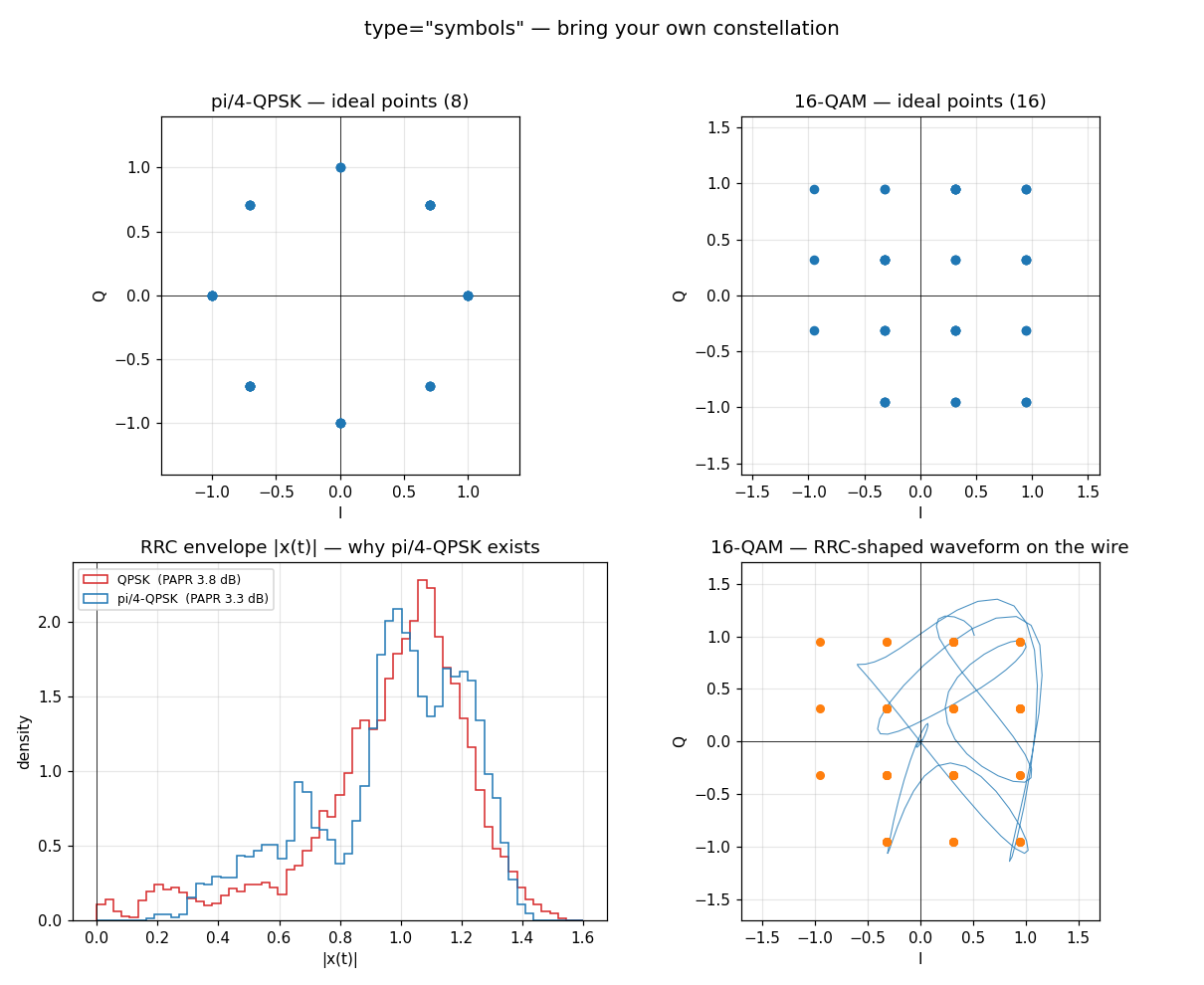
Each constellation is shown two ways — the rect pulse, where a boxcar matched filter recovers the exact points, and the RRC pulse, the continuous band-limited trajectory the radio actually transmits.
Top-left — pi/4-QPSK, ideal points. Two QPSK rings offset by π/4 (eight points), used on alternate symbols. "Compute the symbols, pass them" — there is no π/4-QPSK modulation enum, and none is needed.
Top-right — 16-QAM, ideal points. A 4×4 grid normalised to unit average power. A random symbol stream through the rect pulse; the boxcar matched filter lands exactly on the sixteen points.
Bottom-left — why pi/4-QPSK exists. The distribution of the RRC-shaped
envelope |x(t)| over a long run. Plain QPSK (all symbols from one ring → 180°
flips) drives the envelope clean through zero, so its histogram carries mass at
the origin; pi/4-QPSK (alternating rings → the phase step is capped at ±135°)
has a hard floor near 0.15 and never collapses. That floor drops the
peak-to-average ratio by ~0.5 dB and lets a power amplifier run closer to
saturation — the entire reason the modulation exists.
Bottom-right — 16-QAM, shaped. The RRC-shaped I/Q trajectory threading between the sixteen points — the band-limited waveform actually on the wire, contrasted with the crisp rect grid above it.
The idea
A modulation is just a rule for turning data into constellation points. The
built-in types hard-code that rule; type="symbols" lets you supply the points
directly, so anything you can express as a complex stream is one call away:
import numpy as np
from doppler.wfm import Synth

# pi/4-QPSK: rotate every other QPSK symbol by π/4, then pass the stream
qpsk = np.array([1 + 1j, -1 + 1j, -1 - 1j, 1 - 1j], np.complex64) / np.sqrt(2)
stream = np.array(
    [qpsk[i % 4] * (np.exp(1j * np.pi / 4) if i % 2 else 1) for i in range(64)],
    np.complex64,
)

s = Synth(type="symbols", symbols=stream, sps=4)
iq = s.steps(64 * 4)                       # (256,) complex64
The stream is force-cast to complex64 by the binding, so an np.complex128
array (e.g. anything divided by np.sqrt(2)) is accepted without a manual cast.
Pulse shaping is orthogonal
The same stream, band-limited with a root-raised-cosine pulse — identical to the
shaping the built-in bpsk/qpsk types use:
s = Synth(type="symbols", symbols=stream, sps=8,
          pulse="rrc", rrc_beta=0.35, rrc_span=6)
wire = s.steps(64 * 8)
With the rect pulse (the default), a boxcar matched filter — averaging each
symbol's sps samples — returns the exact points you fed in:
rect = np.asarray(Synth(type="symbols", symbols=stream, sps=8).steps(64 * 8))
recovered = rect.reshape(64, 8).mean(axis=1)   # == stream (to float32)
Carrier and noise compose as usual
freq puts the constellation on a carrier and snr adds AWGN, exactly as for
the built-in modulations:
Rendering through a Composer
For timing, mixing, sequencing, and reproducible seeds, wrap the Synth in a
Segment and render it with a Composer. Note that num_samples /
off_samples belong on Segment.sum, not on Composer:
from doppler.wfm import Segment, Composer

seg = Segment.sum(Synth(type="symbols", symbols=stream, sps=8),
                  fs=1e6, num_samples=4096)
iq = Composer(seg).execute(4096)
From the command line
The CLI takes the constellation as a raw interleaved-I/Q complex64 file:
# write a constellation stream, then generate 100k shaped samples from it
python -c "import numpy as np; \
  np.array([1+1j,-1+1j,-1-1j,1-1j],np.complex64).tofile('qpsk.cf32')"
wfmgen --type symbols --symbols-file qpsk.cf32 --sps 8 \
       --pulse rrc --count 100000 -o wave.cf32
Output is byte-identical to the Python Synth/Composer faces.
Reproduce
See also
- wfmgen — One Engine, Every Waveform — the built-in modulations.
- Composing a Scene — sum, add, headroom, sequencing.
- Python composer API —
Synth/Segment/Composer/Writerin full.