Prepare Once, Sweep Many — the Plan stimulus engine
Evaluating a system — a detector, a demodulator, a synchroniser — means feeding it the same scene at many operating points: a detection or BER curve is a sweep over SNR, each point averaged over independent noise draws. But a composed scene is a linear form,
and the expensive DSP — spreading, root-raised-cosine pulse shaping, the local
oscillator — lives entirely in the signal terms, which do not change when
you sweep a level, a phase, the SNR, or the noise seed. Plan renders each
source once, caches it, and serves every variation as a cheap re-weighted sum.
So a campaign that re-runs one scene hundreds of times pays the signal-synthesis
cost once — and every render is bit-for-bit identical to a full compose.
What you're seeing
The scene is a five-user co-channel CDMA burst (one wanted user carrying the
SNR, four interferers at −3 dBFS) plus a pilot tone. One Plan drives the whole
figure.
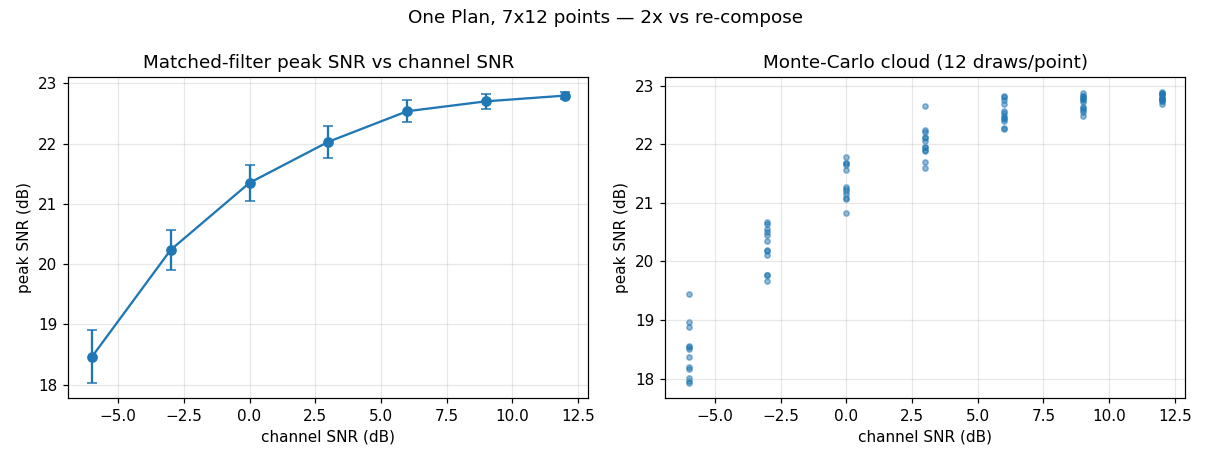
Left — the detection curve. At each swept channel SNR, the wanted user's spreading code is matched-filtered and the correlation-peak SNR recorded, mean ± std over twelve Monte-Carlo noise draws. It climbs with channel SNR and then flattens as the multiple-access interference floor takes over — exactly the multi-user detection knee you would expect, and the cache reproduces the precise noise power the resolver placed at every point.
Right — the Monte-Carlo cloud. The individual per-draw peak SNRs behind each mean: twelve independent noise realizations per SNR, drawn from a seed sweep over one Plan. The signal is identical across draws; only the noise differs.
The title reports the measured speedup of Plan-based stimulus generation over re-composing every point — a few× here, and it grows with the number of sources and the sample count, since that is exactly the signal work the cache elides.
Building it
Prepare a scene, then sweep — the baseline render reproduces a full compose exactly, and every swept point is a re-weight of the cache:
import numpy as np
from doppler.wfm import Composer, Segment, prepare, qpsk, tone

scene = Composer(Segment.sum(
    qpsk(snr=0.0, seed=7, sps=8, pn_length=9),      # the wanted user (anchor)
    qpsk(seed=101, sps=8, pn_length=9, level=-3.0),  # a co-channel interferer
    tone(freq=2.2e5, seed=3, level=-10.0),           # a pilot
    fs=1e6, num_samples=8192,
))

plan = prepare(scene)                       # render + cache every source ONCE
assert np.array_equal(plan.render(), scene.compose())   # baseline is bit-exact

# sweep channel SNR — each point is a cheap re-weight, not a re-synthesis
curve = {snr: plan.at(float(snr)) for snr in range(-6, 15, 3)}

# a Monte-Carlo cloud at one SNR: independent noise, identical signal
draws = list(plan.monte_carlo(6.0, 12, seed0=1000))
assert len({d.tobytes() for d in draws}) == 12          # all realizations differ
render() also takes per-source overrides — gains (dBFS levels), phases
(radians), and enable (drop a source) — so the same Plan sweeps a gain
imbalance or a relative phase just as cheaply:
# disable the interferer, and pull the pilot down 6 dB — no re-synthesis
clean = plan.render(enable=[True, False, True], gains=[0.0, -3.0, -16.0])
Notes
Plan caches a scene whose shape is fixed. That is more than the first
release covered: any number of finite segments, each with its own repeats,
leading delay and trailing gap — fixed or drawn from a range — sharing one
sample rate. A lone bundled noisy source (one source carrying the SNR alone,
its private RNG fused into the signal) is supported too; its AWGN is
reconstructed per instance instead of being a separable multiply.
What prepare() refuses is a scene whose sources move, because then the
cached render is no longer the signal the spec asks for: a ranged source field
(freq=(lo, hi) and friends), a ranged ON-time, or a mix of sample rates. An
unbounded repeat / continuous timeline is out of scope for the same reason —
there is no fixed capacity to cache. Each of those raises ValueError.
Per-source frequency (Doppler) and delay (multipath) overrides remain planned follow-ups on the same frame.
See also
- One Cache Slot for a Whole Background Field —
background=True, for a scene dominated by emitters that never move. - Composing a Scene — building the
Composerscenes a Plan prepares. - WCDMA Carriers — a multi-carrier measurement scene.
src/doppler/examples/plan_demo.py— the script behind this figure.