CIC Decimation Filter
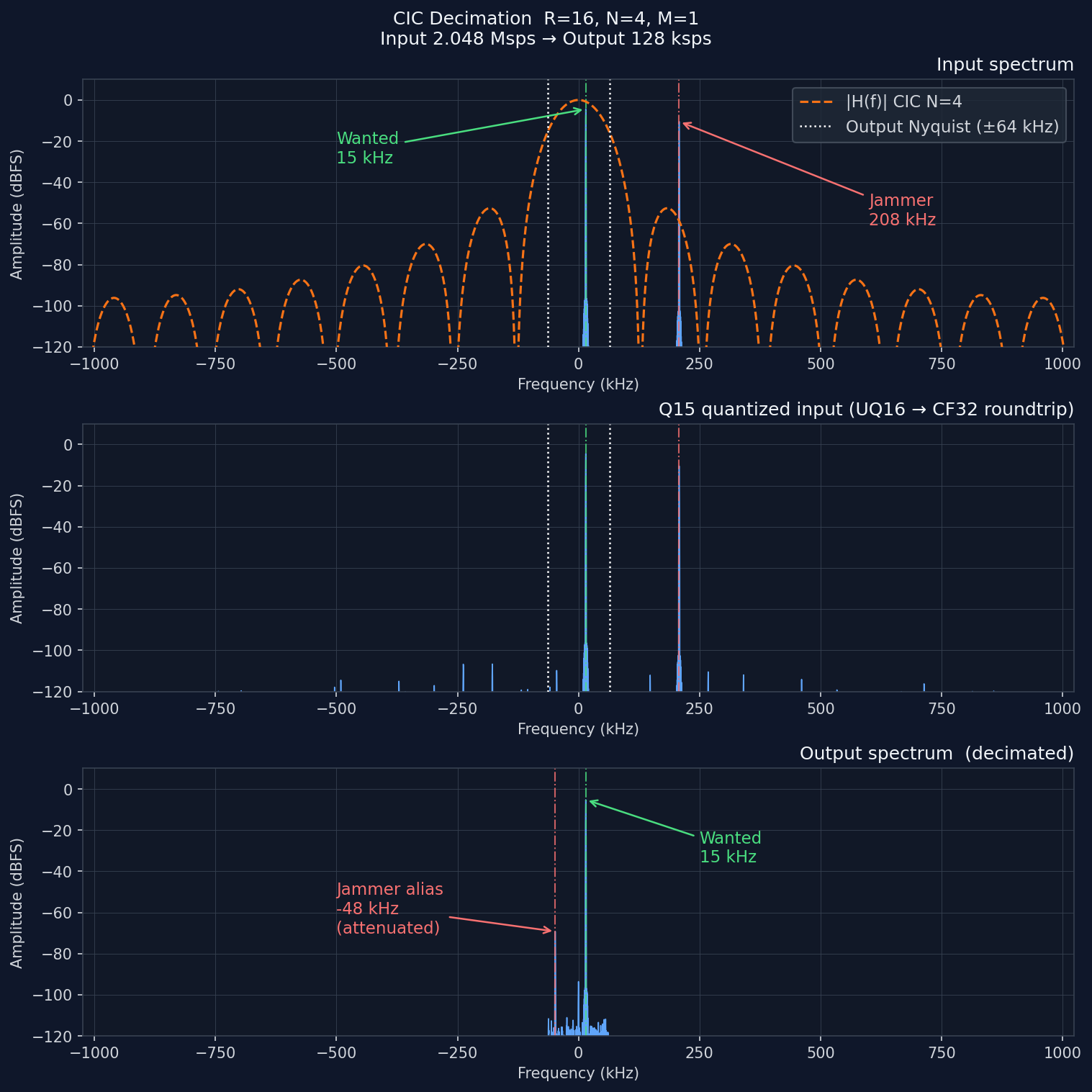
What you're seeing
All three panels share the same x-axis (±1024 kHz = ±fs_in/2) so the signal positions line up vertically across the cascade.
Top panel — wideband input. Two complex tones:
a wanted signal at 15 kHz and a jammer at 208 kHz.
The orange dashed curve is the CIC magnitude response |H(f)|.
The white dotted lines mark the output Nyquist boundaries at ±64 kHz;
anything outside will fold back into the passband.
Middle panel — UQ16 quantized input. The same signal after the CF32 → offset-binary UQ16 → CF32 roundtrip that the CIC applies internally. The quantization noise floor is ~−92 dBFS (Q15 SNR), indistinguishable from the top panel at this scale.
Bottom panel — decimated output. After R=16 decimation, the wanted tone at 15 kHz survives near full amplitude. The jammer at 208 kHz falls in the alias zone and folds to −48 kHz in the output, attenuated by ~90 dB by the CIC filter.
How it works
The CIC transfer function is:
N=4 integrator/comb pairs give 4th-order roll-off with no multiplications.
Internally the filter converts each CF32 sample to offset-binary UQ16
(v_Q15 + 32768 → uint64) so all accumulation is unsigned — intermediate
overflow wraps and cancels exactly across the N stages.
import numpy as np

from doppler.resample import CIC

fs_in = 2.048e6
R = 16
fs_out = fs_in / R  # 128 ksps

f_wanted = 15e3  # survives decimation
f_jammer = 208e3  # alias zone -> folds to -48 kHz in output

A_wanted = 0.6
A_jammer = 0.3  # peak sum 0.9 < 1.0 -- no Q15 clipping

N_IN = 8 * R * 48
t = np.arange(N_IN)
x = (
    A_wanted * np.exp(2j * np.pi * f_wanted / fs_in * t)
    + A_jammer * np.exp(2j * np.pi * f_jammer / fs_in * t)
).astype(np.complex64)

cic = CIC(R)  # R=16, N=4 (fixed), M=1 (fixed)
y = np.array(cic.decimate(x), copy=True)
Transient settling takes approximately CIC_N*(R-1)/R output samples;
drop those before measuring power.
See doppler.resample.CIC
for the full API reference.