RateConverter — Automatic Cascade Selection
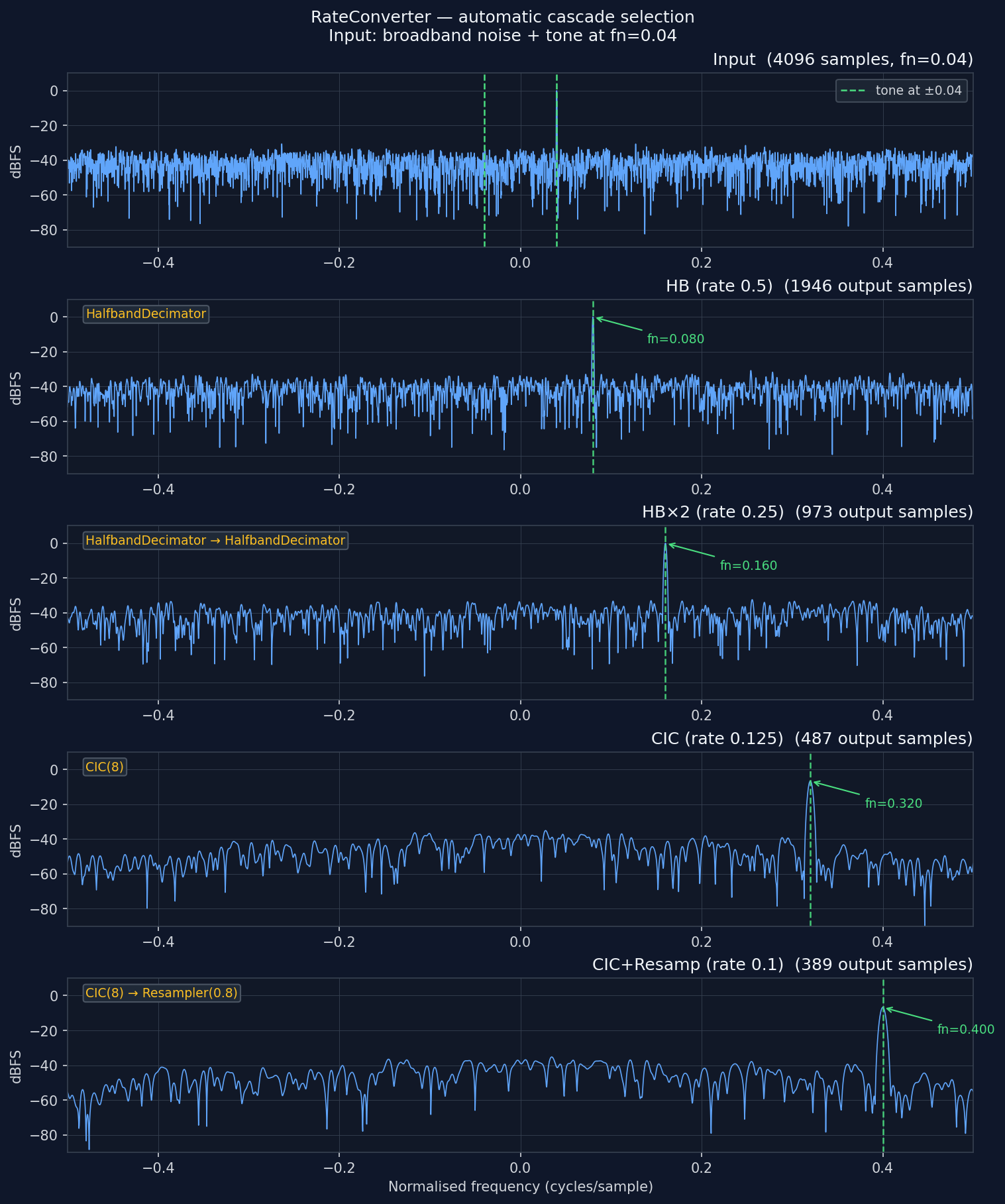
What you're seeing
Five panels share the same x-axis — normalised frequency in cycles/sample (−0.5 to +0.5 = one full output Nyquist interval).
Top panel — input. 4096 samples of broadband complex noise with a single complex tone injected at fn = 0.04 (4 % of the input sample rate). This is the identical signal fed to all four converters below.
Lower four panels — decimated output, one per cascade topology. Each x-axis is normalised to the converter's output sample rate, so the same physical tone moves to a higher normalised frequency as the rate ratio decreases. The yellow label in the top-left corner of each panel names the exact stages RateConverter selected automatically for that rate.
| Panel | rate | D = 1/rate | Cascade selected | Tone at fn_out |
|---|---|---|---|---|
| HB | 0.5 | 2 | HalfbandDecimator | 0.08 |
| HB×2 | 0.25 | 4 | HalfbandDecimator → HalfbandDecimator | 0.16 |
| CIC | 0.125 | 8 | CIC(8) | 0.32 |
| CIC+Resamp | 0.1 | 10 | CIC(8) → Resampler(0.8) | 0.40 |
Every panel annotates the predicted tone position (fn_out = fn_in / rate) with a green marker. Tone recovery is accurate to well under one FFT bin.
How it works
The selection rule is pure arithmetic on D = 1/rate:
rate >= 1.0 or D < 2        →  Resampler(rate)
D ≈ 2^1                     →  HalfbandDecimator
D ≈ 2^2                     →  HalfbandDecimator → HalfbandDecimator
D = 2^n, n>=3, D<=4096      →  CIC(D)
D >= 8, non-power-of-2      →  CIC(R*) → Resampler(R*/D)
otherwise (2 ≤ D < 8)       →  Resampler(rate)
where R* = nearest power-of-two to D. Halfband stages are the cheapest (one multiply per two input samples); CIC has no multiplies at all. The polyphase Resampler handles any rate but is the most compute-intensive, so it is used only when a pure-power-of-two topology cannot be applied.
import numpy as np

from doppler.resample import RateConverter
from doppler.wfm import Composer, Segment

rc = RateConverter(0.1)
print(rc.stages)  # ['CIC(8)', 'Resampler(0.8)']

x = np.asarray(Composer([Segment(type="noise", num_samples=4096)]).compose())
y = rc.execute(x)  # len(y) ≈ 410
print(len(y))

# Change rate — cascade is rebuilt automatically
rc.rate = 0.25
print(rc.stages)  # ['HalfbandDecimator', 'HalfbandDecimator']
The execute buffer is grown lazily on the first call and invalidated on every rate change, so callers pay no per-call allocation overhead in steady state.
Streaming — phase-continuous across blocks
execute() carries filter state across calls, so a stream split at any block
boundary is byte-identical to one large call.
The result is a zero-copy view — copy it to keep it
execute() returns a zero-copy view into the converter's internal
output buffer, valid only until you next touch the converter. Two things
invalidate it: the next execute() reuses the buffer in place, and
reset(), assigning .rate, or a block larger than any seen so far
reallocates it. .copy() any result you need to retain. The common
fixed-block streaming loop (consume each block before the next call) needs
no copy.
import numpy as np
from doppler.resample import RateConverter

x = np.random.randn(2048).astype(np.complex64)
y_full = RateConverter(0.5).execute(x).copy()

rc = RateConverter(0.5)
y_split = np.concatenate([
    rc.execute(x[:1024]).copy(),   # copy: the next execute() reuses the buffer
    rc.execute(x[1024:]).copy(),
])
assert np.array_equal(y_full, y_split)   # byte-identical ✓
CIC droop compensation
compensate=1 appends a passband-droop compensating FIR (ciccompmf(N=4, R=R, M=7)) after any CIC stage, correcting the |sin(x)/x|⁴ roll-off at
negligible cost (7 taps at the decimated rate):
print(RateConverter(0.125).stages)                 # ['CIC(8)']
print(RateConverter(0.125, compensate=1).stages)   # ['CIC(8)+FIR']
Functional interface
rate_convert() wraps construction so state can persist across calls: it
creates a RateConverter on the first call and returns it to reuse:
from doppler.resample import rate_convert

y1, rc = rate_convert(x, 0.5)          # creates RateConverter(0.5)
y2, rc = rate_convert(x, 0.5, rc=rc)   # reuses it — state preserved
See
doppler.resample.RateConverter
for the full API reference, and the
Resampler design notes for the polyphase
interpolator/decimator architecture underneath it.