Farrow Interpolator
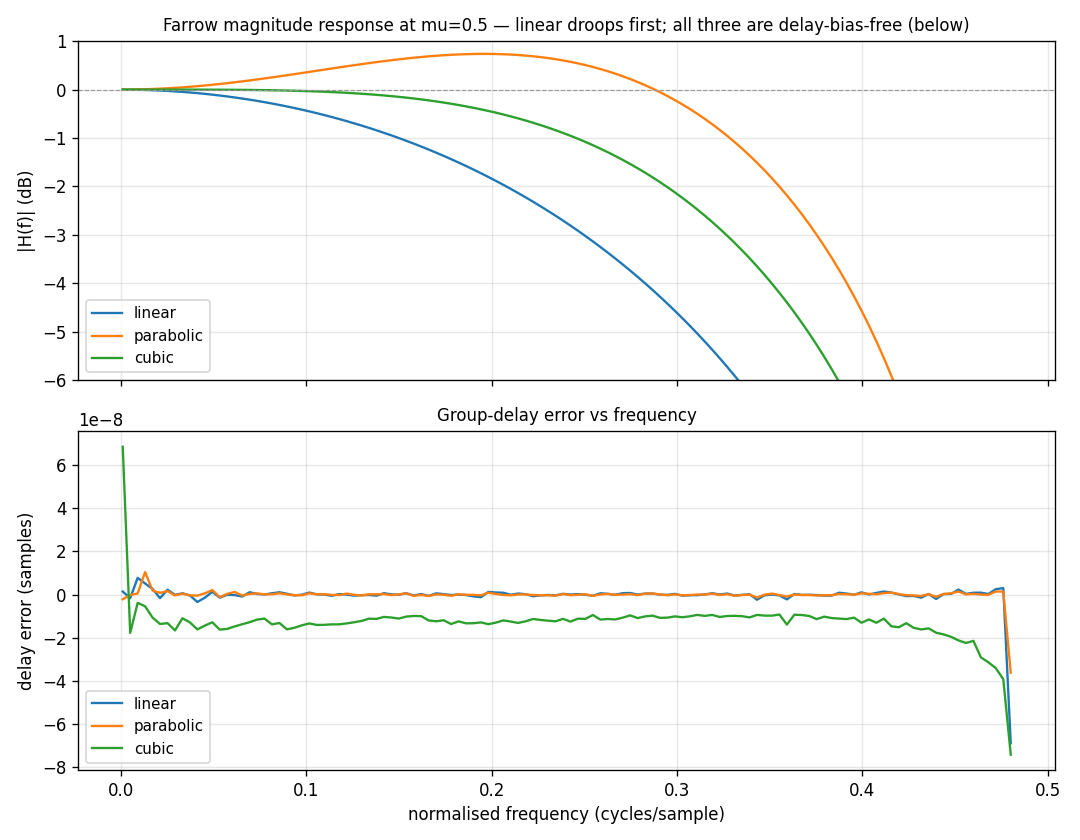
A resample.Farrow fractional-delay interpolator —
the lean, sample-by-sample alternative to a polyphase resampler when all you need
is a fractional tap (a symbol-timing loop's interpolator). It has three
selectable orders — linear, parabolic, cubic — sharing one 4-tap delay
line and a fixed 2-sample group delay, so a driving timing loop is
order-agnostic.
The plot sweeps a tone across the band, interpolates it at a half-sample delay
(µ = 0.5, the worst case), and measures the interpolator's response per order.
What you're seeing
Top — Magnitude response. |H(f)| in dB. An ideal fractional delay is 0 dB
everywhere. Linear droops first; the symmetric piecewise-parabolic carries a
slight passband bump but holds the band further; cubic is flattest near DC.
Higher order buys usable bandwidth for a few more taps.
Bottom — Group-delay error. All three are symmetric about the
interpolation point, so the realised delay matches the requested µ to within
float noise (the axis is ×10⁻⁸) across the whole band — no timing bias. That
linear-phase property is exactly why these interpolators suit a timing loop: the
loop estimates µ, the interpolator delivers that delay without skewing it.
How it works
Each order is a polynomial in µ (Horner form) over the 4-tap window; the
fractional offset µ ∈ [0,1) comes from an integer timing NCO (the post-wrap
accumulator value), so the timing accumulation stays exact while only the
interpolation is floating point.
import numpy as np

from doppler.resample import Farrow

x = np.exp(2j * np.pi * 0.05 * np.arange(256)).astype(np.complex64)

f = Farrow(order="cubic")          # "linear" | "parabolic" | "cubic"
y = f.delay(x, mu=0.3)             # constant fractional delay mu of a block
# or drive it sample-by-sample for a timing loop:
#   farrow_push(x[n]) every sample; farrow_eval(mu) on a symbol strobe
This is the interpolation half of a symbol synchronizer: the integer NCO gives
the symbol strobe and µ for free on overflow, and the Farrow produces the
sample at that instant.
Source: src/doppler/examples/farrow_demo.py.