Doppler Channel — Clock Doppler as a Propagation Impairment
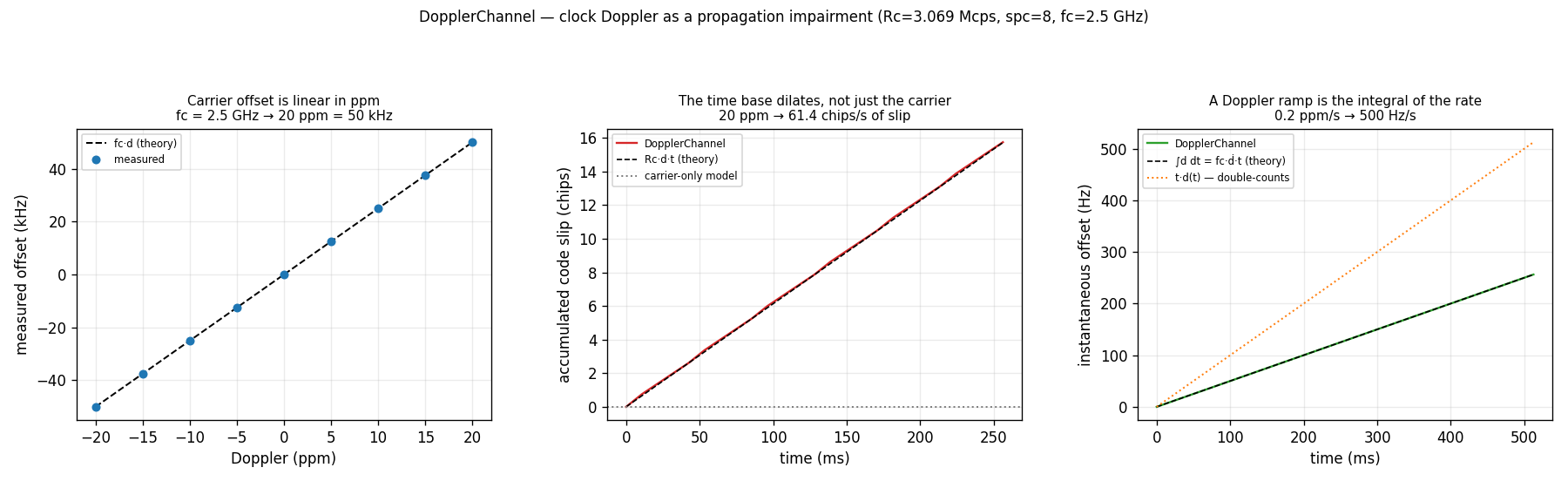
A Doppler shift is not a frequency offset. Relative motion rescales the entire received time base, so every clock in the signal changes together — carrier, chip rate, symbol rate, frame rate. Modelling only the carrier is the usual shortcut, and it silently deletes the one error a delay-lock loop exists to track.
impairment.DopplerChannel applies both halves of the effect from a single
parameter, so they cannot disagree with each other.
What you're seeing
Left — the carrier offset is linear in ppm. Doppler is specified in parts
per million of the nominal time base, which is what makes it
carrier-frequency agnostic. At the 2.5 GHz carrier of
the async DSSS receiver spec, that spec's ±50 kHz frequency
uncertainty is exactly ±20 ppm. Measured FFT peaks sit on the fc·d line
across the sweep.
Centre — the time base dilates. This is the panel a carrier-only model gets
wrong: it would be flat on the dotted zero line. The real channel accumulates
code phase at Rc·d — 61.4 chips per second at 20 ppm on a 3.069 Mcps
code. Over the 256 ms plotted, that is 16 chips the receiver's code loop has to
make up. The trace is quantised to an eighth of a chip because slip is counted
in whole samples at spc=8.
Right — a Doppler ramp is the integral of the rate. With
doppler_rate_ppm_s = 0.2 (SPEC.md's 500 Hz/s at 2.5 GHz), the instantaneous
offset climbs as fc·ḋ·t. The dotted orange line is the natural wrong
implementation — accumulating t·d(t) instead of ∫d dt double-counts the
ramp and lands at exactly twice the truth. It is the one error that passes every
static-Doppler check, which is why both the C and Python test suites assert
against it specifically.
How it works
The dilation is a resampling of the whole stream at output/input ratio
1/(1+d), which is what makes it apply to every clock at once rather than to
each one separately. It reuses resample.Resampler's per-sample rate control
(resamp_execute_ctrl), whose double-precision accumulator tracks a Doppler
ramp exactly instead of approximating it with a piecewise-constant ratio
re-set once per block. No resampling math is reimplemented.
The carrier is then exp(j·2π·fc·excess(t)), where excess(t) = ∫d dt is the
same dilation integral the resampler ratio came from — one number, so the code
rate and the carrier can never drift apart.
carrier_hz is load-bearing here, not metadata
Everywhere else in this codebase --fc is a SigMF annotation that never
touches a sample. In DopplerChannel it is DSP input, and unavoidably so:
Doppler is dimensionless ppm, and fc is the only thing that converts it
into Hz. Setting it to 0 still dilates the clocks correctly but leaves the
carrier stationary — permitted, because it is occasionally useful for
isolating a code loop under test, but not what a real channel does.
What is deliberately not plotted: under a Doppler rate the code slips
quadratically, Rc·½·ḋ·t². At SPEC.md's 0.2 ppm/s that is 0.08 chips over the
whole half-second run — a fraction of a single sample, below what sample
counting can resolve. The carrier effect of a ramp is first order and plainly
visible; the code effect is second order and, over a realistic dwell,
negligible.
import numpy as np

from doppler.impairment import DopplerChannel

# SPEC.md geometry, with its RF numbers restated as ppm of the time base.
CHIP_RATE = 3.069e6  # Mcps
SPC = 8  # samples per chip
FS = CHIP_RATE * SPC  # 24.552 MS/s
FC = 2.5e9  # RF carrier -- load-bearing, not metadata
PPM = 20.0  # +/-50 kHz at 2.5 GHz
RATE_PPM_S = 0.2  # 500 Hz/s at 2.5 GHz


def apply_doppler(x: np.ndarray, ppm: float, rate_ppm_s: float = 0.0):
    """Push ``x`` through a Doppler channel; return ``(y, channel)``.

    The channel dilates the time base *and* shifts the carrier, both derived
    from ``ppm``. Output is shorter than input by roughly ``ppm`` parts per
    million -- that missing time is the dilation.
    """
    ch = DopplerChannel(
        fs=FS,
        carrier_hz=FC,
        doppler_ppm=ppm,
        doppler_rate_ppm_s=rate_ppm_s,
    )
    return ch.execute(x.astype(np.complex64)), ch