Name Your Own Code — and What Happens Past the Radius
doppler.coding holds the code families a standard configures, rather
than any standard's picks. ReedSolomon is both directions of an RS code over
GF(2**J); ConvEncoder and Viterbi are the two directions of a rate-1/n
convolutional code. All three take the code as arguments, so the chain below
uses one that is nobody's standard: RS(255,239) over the textbook GF(256)
inside a K=7 rate-1/2 inner code with no output inverted.
That is the point of the slice this page came from. Until gh-900 doppler could decode any convolutional code and encode exactly one, and the only Reed-Solomon reachable from Python was CCSDS's — fixed, and only inside a frame descriptor that carries an interleaving depth rather than a code.
The chain
Outer code, marker, inner code; then a real AWGN channel; then back up through Viterbi, acquisition, and Reed-Solomon.
import numpy as np

from doppler.coding import ConvEncoder, ReedSolomon, Viterbi
from doppler.detection import SyncFinder

# A code that is nobody's standard: RS(255,239) over the textbook GF(256),
# and the K=7 rate-1/2 inner code with NOTHING inverted (CCSDS complements
# its second output; this does not).
OUTER = {"nroots": 16}
INNER_POLY = [0o171, 0o133]
K_INNER = 7
DEPTH = 35

# A Viterbi decoder answers LATE: it holds `depth - 1` decisions back while
# the traceback catches up, so a frame encoded with nothing after it comes
# out short by exactly that much and its tail is never emitted. Flushing the
# encoder with `depth` known bits is what buys the tail back -- the classic
# thing to forget, and it presents as a frame that is the wrong length rather
# than as anything that looks like a coding problem.
TAIL = np.zeros(DEPTH, np.uint8)

# A 32-bit marker of our own, for the same reason CCSDS has one: a receiver
# has to find where the frame starts, and the marker is what tells it -- and
# in which polarity.
MARKER = np.unpackbits(np.frombuffer(b"\xd3\x91\x2a\x7c", np.uint8))


def encode_frame(payload: np.ndarray) -> np.ndarray:
    """Payload octets -> channel symbols: outer code, marker, inner code."""
    rs = ReedSolomon(**OUTER)
    codeword = rs.encode(payload)  # k info + 2E parity
    bits = np.unpackbits(codeword)

    # The marker is prepended AFTER the outer code and covered by the inner
    # one -- the coverage asymmetry every framing with a sync word has.
    framed = np.concatenate([MARKER, bits, TAIL]).astype(np.uint8)
    return ConvEncoder(INNER_POLY, k=K_INNER).encode(framed)


def decode_frame(llr: np.ndarray, n_frame_bits: int) -> np.ndarray | None:
    """Channel LLRs -> payload octets, or None if the frame is unusable."""
    bits = Viterbi(INNER_POLY, k=K_INNER, depth=DEPTH).decode(llr)

    # Acquire: where does the frame start, and which polarity is it in?
    hit = SyncFinder(MARKER).find(bits, max_errors=4)
    if not hit.found:
        return None
    body = bits[hit.offset + MARKER.size : hit.offset + n_frame_bits]
    if hit.inverted:
        body = (body ^ 1).astype(np.uint8)

    rs = ReedSolomon(**OUTER)
    if body.size != rs.n * 8:
        return None
    word = np.packbits(body)
    if rs.decode(word) < 0:
        return None  # too far from any codeword
    return word[: rs.k]
Two details in there are worth pulling out, because both present as something other than what they are.
The marker is prepended after the outer code and covered by the inner one.
That coverage asymmetry is not a CCSDS quirk — every framing with a sync word
has it, because a receiver has to find the marker before it can undo
anything, so the marker cannot be inside what it is used to find. It is also
what reports polarity: SyncFinder returns inverted, and a BPSK carrier
locked 180 degrees out delivers every bit complemented.
A Viterbi decoder answers late. It holds depth - 1 decisions back while
the traceback catches up, so a frame encoded with nothing after it comes out
short by exactly that much and its tail never arrives. Flushing the encoder
with depth known bits buys it back. Forget it and the symptom is a frame of
the wrong length — which looks like a framing bug, not a coding one.
Past the radius, a decoder can be silently wrong
rs_core.h states it and nothing showed it:
beyond
Ea bounded-distance decoder can land inside another codeword's sphere and miscorrect — a property of the code, not of this implementation
Three outcomes, and only two of them are safe:
| outcome | decode returns |
codeword_ok |
the receiver |
|---|---|---|---|
| corrected | 0..E |
yes | has the right payload |
| refused | -1 |
— | knows it failed |
| miscorrected | 0..E |
yes | does not know |
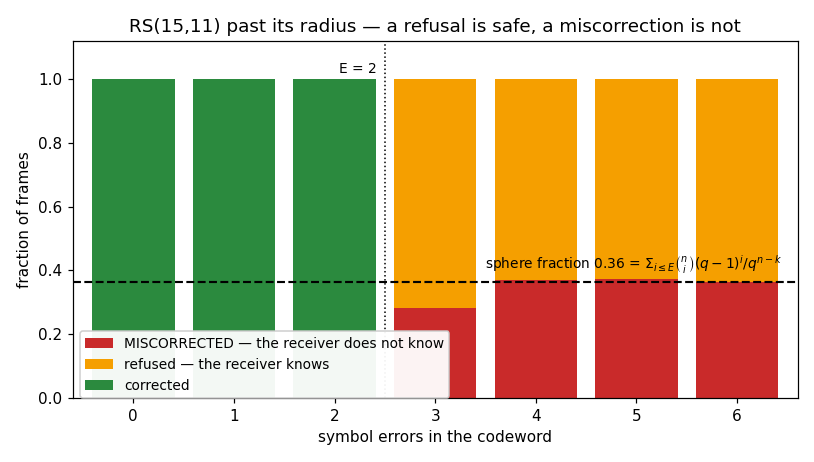
The plot above is the fraction of frames in each state as the error count
crosses E. Everything within the radius is corrected; one symbol past it,
nothing is — and roughly a third of those frames come back as a different
codeword, reported as a successful decode.
Why the plot uses a deliberately weak code
The figure is RS(15,11) over GF(16), which nothing sends. The reason is the measurement, not the story.
A random error pattern lands in some codeword's sphere with probability about
The q**k codewords cancel, so only the parity count survives — and that
is the whole engineering content of this page. For RS(255,239) the fraction is
2e-05; for RS(15,11) it is 0.36. Sweeping the strong code would need a
quarter of a million frames to see a handful of events, and an example
reporting zero would be reporting its own sample size.
The dashed line on the plot is that closed form. The measured miscorrection
rate converges onto it well past E, where the corrupted word is effectively
a random one — measurement meeting theory with nothing shared between them but
the code's four parameters. The example asserts that convergence, so a
regression in the decoder shows up as a failing example rather than a
different-looking picture.
Read the scaling, not the number. Parity is what buys the silence, and it
buys it exponentially: every extra parity symbol divides the miscorrection
probability by q. What it never buys is certainty, which is why frame-level
accounting — a CRC inside the codeword, or the corrected / symbols counts
FrameDesc.check() reports — is the thing that catches the rest.
Run it
The script self-validates: it asserts the payload comes back bit-exact
through the channel, that every pattern within E is corrected and none
beyond it is, and that the far tail matches the sphere-packing fraction.