Arbitrary-Rate Symbol Recovery
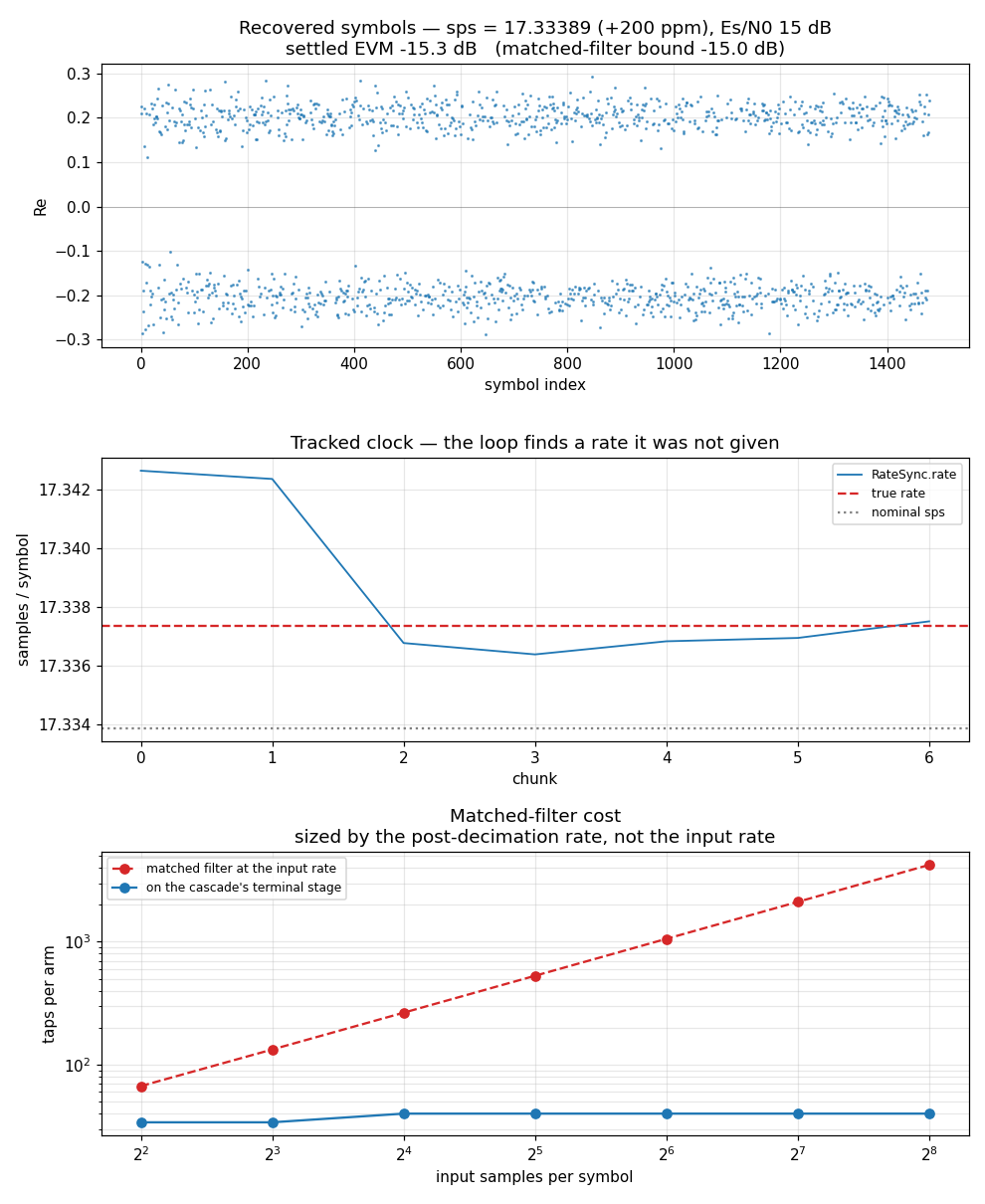
track.RateSync recovers symbols from a stream whose
sample clock has no integer relationship to the symbol clock — here 17.33389
samples per symbol, and 200 ppm off even that.
It gets there by inverting the usual arrangement. Where
SymbolSync runs a matched FIR and then a separate
Farrow interpolator steered by an integer NCO, RateSync owns a
MatchedRateConverter whose terminal stage carries the
pulse. The cascade's last dot product is the matched filter, and the
polyphase arm that dot product selects is the fractional timing delay. One
filter, no Farrow, no separate matched-filtering pass — and because that
stage's accumulator is a double, sps is a double.
What you're seeing
Top — Recovered symbols. The real part per symbol index: a short pull-in
while the loop acquires, then clean rails — at a fractional sps, with the
clock 200 ppm off nominal.
The noise is quoted as Es/N0, not as an "SNR": at 17.33 samples per symbol those differ by more than 12 dB, so the same number would describe two very different links. The noise is complex, N0 total — a real receiver's baseband is complex and its Q channel carries noise even when the modulation is real.
At the matched-filter output the error vector is that complex noise, of total variance N0, against a reference of energy Es. So on the I/Q plane
(The familiar factor of two belongs to an I-only measurement, which discards the Q channel. EVM is a plane quantity unless it says otherwise.)
Measured, ten seeds per point:
| Es/N0 | bound | measured | offset |
|---|---|---|---|
| 10 dB | −10.0 dB | −10.02 dB | −0.02 dB |
| 15 dB | −15.0 dB | −15.01 dB | −0.01 dB |
| 20 dB | −20.0 dB | −19.97 dB | +0.03 dB |
So the fused matched filter is on the bound, across a 10 dB span — fusing it into the resampler's polyphase bank costs nothing in detection performance. It is the same filter, evaluated at a steered instant.
(One 375-symbol window carries ~0.3 dB of estimator noise, so a single seed lands either side. The script asserts ±1.5 dB at three operating points rather than pretending one measurement is tighter than it is.)
Middle — Tracked clock. RateSync.rate pulling off the nominal it was
constructed with (dotted) onto the stream's true rate (dashed). The loop is
tracking an asynchronous, non-integer clock; rate reports the truth, which
is what a caller disciplining a clock reads. It is taken from the loop
integrator, not the instantaneous control — the integrator is the rate
memory, and reading the noisy total instead biases the estimate.
Bottom — Matched-filter cost. Taps per arm against input samples per
symbol. Applied at the input rate (red) a root-raised-cosine matched filter
grows linearly with sps — 4225 taps per arm at 256 samples/symbol, some 35 MB
of bank. Riding the cascade's terminal stage (blue) it is flat: the HB/CIC
stages ahead of it have already done the bulk decimation, at no multiplies, so
the filter is sized by the post-decimation rate. The single 34 → 40 step is
the CIC droop compensator folding into the bank once the planner picks a CIC; a
halfband cascade has no droop to correct.
How it works
The receiver is one object and one call. sps is the nominal rate — the loop
finds the true one:
import numpy as np

from doppler.ber import ber_evm_db, ber_settle_syms
from doppler.track import RateSync
from doppler.wfm import rrc_h

SPS = 17.33389  # non-integer samples per symbol -- the whole point
BETA = 0.35
SPAN = 8
BN = 0.005  # loop bandwidth, symbol-rate normalised
CLOCK_PPM = 200.0  # the true rate is this far off the nominal
ES_N0_DB = 15.0  # symbol energy to noise density -- NOT a per-sample SNR

# Long enough that a SETTLED window exists. `ber_settle_syms` is the
# library's own answer to where steady state may start -- 2*(5/Bn) for the
# one running loop, which is 2000 symbols at Bn = 0.005. A record pinned to
# a round number instead (this demo used 1500) is shorter than its own
# settling budget, so "the last quarter" was measuring the tail of the
# acquisition transient and calling it steady state.
NSYM = 3 * int(ber_settle_syms(BN, 0.0))


def make_signal(sps, tau=0.37, seed=7, es_n0_db=ES_N0_DB):
    """RRC-shaped BPSK at a fractional sps, offset by tau, in AWGN.

    Noise is set from **Es/N0**, the symbol energy over the noise density,
    because "SNR" alone is ambiguous here: at 17.33 samples per symbol a
    per-sample SNR is ~12 dB below the Es/N0 the receiver actually sees, so
    the same number means two very different links.

    The noise is **complex**, N0 total (N0/2 per dimension), because a real
    receiver's baseband is complex and its Q channel carries noise even when
    the modulation is real. Injecting real-only noise instead is the same
    thing as discarding Q, and it flatters the reported EVM by 3 dB against
    the convention everyone else quotes -- EVM is measured on the I/Q plane
    unless it says otherwise.

    Symbols are presented at the CONTRACTED unit amplitude, and that is the
    whole of the level story. RateSync carries no AGC by design -- a
    composing receiver already levels in its own front-end cascade -- so the
    caller owns the input level, and the level to hit is not a tuned number:
    the TED normalises by its own construct-time slope, computed for the
    reference the matched bank already defines
    (``RateConverter_agc_ref_db()`` = ``10*log10(bank_e0/bank_sps)``, ~0 dB
    because the bank normalises by its own pulse energy).

    This demo used to scale the shaped stream to ``0.25`` of its PEAK for
    "CIC headroom", and it is worth naming what that cost. An RRC stream
    peaks at ~1.582x its symbol amplitude, so symbols arrived at ~0.158
    against a contract written in unit amplitude -- and a Gardner detector's
    slope goes as A^2, so the loop ran ~40x under its stated bandwidth and
    failed its own lock assertion with nothing pointing at the level. The
    peak backoff was also a hand-rolled AGC: a peak detector with no loop
    and no time constant.

    That ``A^2`` is **Gardner's exponent, not the object's**: the two
    detectors do not share an amplitude law. Gardner's raw error is a
    product of two signal samples and carries ``A^2``; DTTL's multiplies
    one signal sample by a difference of hard-decision SIGNS, which is
    amplitude-free, so it carries ``A^1``. Both are measured -- fitted
    2.000 and 1.000 -- in section 2.6b of the validation report. The level
    CONTRACT is the same either way, but the penalty for missing it is
    squared for the default detector and linear for the other, so the same
    0.158 mistake above would have cost ~6x rather than ~40x under DTTL.

    The CIC's input bound is **2.0**, not 1.0 -- ``CIC_PAPR_HEADROOM``
    reserves exactly the 6 dB a unit-amplitude RRC's 1.582 peak needs, so
    the contracted level fits with margin. What does not fit is the NOISE:
    15 dB Es/N0 at 17.33 samples per symbol is only ~2.6 dB per-sample SNR,
    so the composite crest runs past the bound on noise alone. See the note
    beside the assertions below, and gh-668.
    """
    rng = np.random.default_rng(seed)
    syms = np.where(rng.integers(0, 2, NSYM) > 0, 1.0, -1.0)
    n = int(NSYM * sps) + 64
    idx = np.arange(n, dtype=float)
    x = np.zeros(n)
    for k, a in enumerate(syms):
        t = (idx - (k + SPAN) * sps) / sps - tau
        near = np.abs(t) <= SPAN
        x[near] += a * rrc_h(t[near], BETA)
    # Average symbol energy from the STEADY-STATE span only. Including the
    # ramp-up and the tail padding underestimates the power, which would
    # quietly set a higher Es/N0 than advertised -- and the giveaway is an
    # EVM that beats the matched-filter bound, which nothing can do.
    core = x[int(SPAN * sps) : -int(SPAN * sps)]
    es = np.mean(core**2) * sps
    n0 = es / 10 ** (es_n0_db / 10)
    noise = (rng.standard_normal(n) + 1j * rng.standard_normal(n)) * np.sqrt(
        n0 / 2
    )
    return (x + noise).astype(np.complex64), syms


def evm_floor_db(es_n0_db=ES_N0_DB):
    """Matched-filter EVM bound on the I/Q plane.

    At the matched-filter output the error vector is the complex noise, of
    total variance N0, against a reference of energy Es -- so
    EVM^2 = N0/Es and the bound in dB is simply -(Es/N0). (The familiar
    factor of two belongs to an I-only measurement, which discards the Q
    channel; EVM is a plane quantity unless stated otherwise.)
    """
    return -es_n0_db


# The receiver: one object, one call. `sps` is the NOMINAL rate -- the loop
# finds the true one, which is 200 ppm away.
true_sps = SPS * (1.0 + CLOCK_PPM * 1e-6)
rx, tx_syms = make_signal(true_sps)

sync = RateSync(sps=SPS, pulse="rrc", beta=BETA, span=SPAN, m=2, bn=BN)
symbols = np.asarray(sync.steps(rx))
RateSync asks its MatchedRateConverter for rate = m/sps and lets the planner
decide the shape. At sps = 17.33389 with m = 2 that is CIC(8) followed by
a Resampler(0.923, rrc): the CIC throws away the bulk of the rate for free,
and the fractional remainder lands on the stage that carries the pulse. Ask for
sps = 64 instead and the plan becomes CIC(32) + Resampler(1.0, rrc) — the
same bank, a 32× cheaper front end.
That terminal stage always exists when a pulse is selected, even when the rate
divides exactly. It is not there to correct the rate; it is the matched filter
and the timing element, and a cascade that ended in a bare CIC(32) would
have nothing steerable at the end.
Every m-th terminal output is the on-time strobe and the output m/2 back is
the Gardner transition gate, so the oversampled stream and the symbol stream
come out of the same dot products. A half-symbol error in that assignment is
an equilibrium of the detector — but an unstable one: each parity's S-curve
has one zero at the eye centre and one at the T/2 point, crossing in opposite
senses, so the loop runs away from the wrong one unaided. No eye-sign detector,
no counter flip, and no second bank — and nothing that inspects the signal,
which is what lets the escape work on noise or on a buffer of zeros just as
well as on a modulated stream.
The cost claim in the third panel is measured, not asserted:
from doppler.resample import MatchedRateConverter  # noqa: E402


# Why a high input rate is nearly free: the cascade's HB/CIC stages do the
# bulk decimation at no multiplies, so the matched filter is sized by the
# POST-decimation rate. Applied at the input rate it would grow with sps.
def bank_cost(sps_values, span=SPAN, m=2):
    """(taps/arm on the cascade, taps/arm at the input rate) per sps."""
    cascade, at_input = [], []
    for s in sps_values:
        rc = MatchedRateConverter(
            rate=m / s,
            compensate=1,
            pulse="rrc",
            span=span,
            pulse_sps=float(m),
        )
        cascade.append(rc.bank_shape[1])
        at_input.append(int(np.ceil((2 * span + 1.0 / m) * s)) + 1)
    return np.array(cascade), np.array(at_input)
Reading the object honestly
Two habits worth forming, both of which cost real debugging time to learn:
Judge lock by lock_stat / locked, not by an error-vector magnitude. A
single cycle slip during acquisition drags a windowed EVM by 20 dB while the
eye is wide open at +0.75. The eye statistic is the honest indicator; EVM is
only meaningful once the loop has settled.
Check clipped at least once against real input. The cascade inherits its
CIC's ±1.0 input bound, and an overdriven front end costs about 25 dB of EVM
with a perfectly healthy lock — nothing in the timing metrics reveals it. That
is exactly why the flag exists.
One tuning note: use m >= 4 with pulse="iandd". The rectangle is one symbol
wide, so at m = 2 its matched filter is a two-tap sum and the eye barely
opens — measured on an NRZ stream, m = 2 does not clear the lock detector's
own declare threshold while m = 4 clears it comfortably, with tens of dB of
EVM between them. The rule rests on that separation, not on a particular pair
of lock_stat values: those move with sps and with the stream. The RRC spans
many symbols and is unaffected.
Choosing a detector
ted is the one knob here whose two settings are both correct, so it is a
choice rather than a default. The demo recovers the same stream with each:
def compare_detectors(rx_signal=None):
    """Recover the same stream with each timing-error detector.

    `ted` is the one knob on this object whose two settings are both
    correct, so it is a CHOICE rather than a default -- and a demo that
    only ever builds the default leaves a caller with no way to make it.

    Returns ``{name: (evm_db, lock_stat, locked)}``.
    """
    rx_signal = rx if rx_signal is None else rx_signal
    out = {}
    for name in ("gardner", "dttl"):
        obj = RateSync(
            sps=SPS, pulse="rrc", beta=BETA, span=SPAN, m=2, bn=BN, ted=name
        )
        y = np.asarray(obj.steps(rx_signal))
        out[name] = (_evm_db(y), float(obj.lock_stat), bool(obj.locked))
    return out


# How to choose, given both lock and (at this Es/N0) both land on the
# matched-filter floor:
#
#   gardner  blind. Works for any constellation, and its `bn` means the
#            same loop bandwidth at every roll-off -- measured flat across
#            beta 0.1 to 0.9. The default, and the safe one.
#   dttl     decision-directed. Lower self-noise near lock: on a NOISELESS
#            stream it rests ~6x closer to the eye centre, because Gardner
#            pays a self-noise cost on every non-transition symbol and DTTL
#            gates those out. Costs: BPSK/QPSK only (it assumes rectangular
#            I/Q decision boundaries), and its effective loop bandwidth
#            currently varies ~8x across the roll-off range, so `bn` does
#            NOT mean one bandwidth for it -- doppler#669.
#
# The EVM the two reach HERE is the same, and that is the point worth
# taking away: at a realistic Es/N0 the noise dominates and the detector
# choice does not move the number. DTTL's advantage is a self-noise
# advantage, so it shows where self-noise is what is left.
gardner (default) |
dttl |
|
|---|---|---|
| kind | blind | decision-directed |
| constellations | any | BPSK/QPSK only |
| self-noise near lock | pays on every non-transition symbol | gates those out — rests ~6x closer to the eye centre on a noiseless stream |
does bn mean one bandwidth? |
yes — flat across roll-off | no — varies ~8x over beta 0.1–0.9 (#669) |
| level error costs | A² — a 2x error is 4x the loop gain |
A¹ — a 2x error is 2x |
At a realistic Es/N0 the noise dominates and the two reach the same EVM, which
is what the demo asserts. DTTL's advantage is a self-noise advantage, so it
shows where self-noise is what is left. Start with gardner.
The C composition API
RateSync splits into a cascade and a timing loop so a receiver can inline the
per-sample step into its own loop rather than calling a block API — which is
exactly what MpskReceiver does, steering the same accumulator through its
DDC's rate_ctrl port. The object form is the same call from C:
#include <doppler/ratesync/ratesync_core.h>
#include <complex.h>
#include <stdio.h>

int main(void)
{
    /* 17.33389 samples/symbol -- a free-running ADC clock against the
       symbol clock -- RRC beta 0.35 span 8, m = 2 outputs/symbol, a
       1024-arm bank, bn 0.01, zeta 0.707, blind Gardner detector. */
    ratesync_state_t *rs = ratesync_create(17.33389, RATESYNC_PULSE_RRC,
                                           0.35, 8, 2, 1024, 0.01, 0.707,
                                           RATESYNC_TED_GARDNER);
    if (!rs)
        return 1;

    float complex x[4096];
    for (int i = 0; i < 4096; i++)
        x[i] = 0.0f;  /* your baseband goes here */

    /* One input in, at most one symbol out. This is the call a receiver
       inlines; ratesync_steps() is the block form over the same body. */
    float complex sym;
    long got = 0;
    for (int i = 0; i < 4096; i++)
        if (ratesync_step(rs, x[i], &sym))
            got++;

    printf("%ld symbols, rate %.5f, locked %d\n", got,
           ratesync_get_rate(rs), ratesync_get_locked(rs));
    ratesync_destroy(rs);
    return 0;
}
SymbolSync is unchanged and remains the right answer when the matched filter
is not one this family builds, or when the front end is already at a small
integer sps and a Farrow interpolator is the cheaper shape.