Timing Loop — Theory Validation
A theoretical-correctness check on track.SymbolSync's
Gardner timing-error detector.
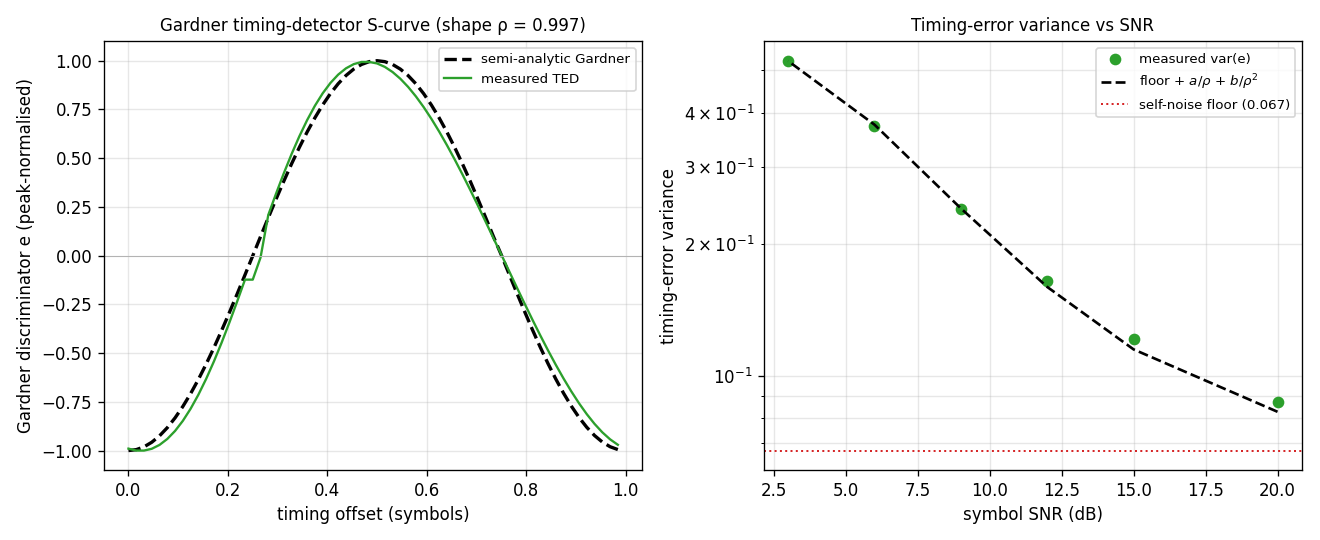
Left — Timing-detector S-curve. The open-loop TED (swept static timing offset, bandwidth → 0) matches a semi-analytic Gardner reference computed directly from the pulse train (shape correlation ρ ≈ 0.997). The characteristic is period-one-symbol with two zeros a half-symbol apart — the stable lock (positive restoring slope) and the unstable null. (The two timing references differ by the Farrow's fixed 2-sample group delay, removed by a peak-normalise + circular alignment.)
Right — Timing-error variance vs SNR. var(e) is a data-pattern
self-noise floor (≈ 0.067, present even at infinite SNR — a defining Gardner
property) plus an AWGN contribution that grows as 1/SNR (signal×noise) and
1/SNR² (noise×noise); the floor + a/ρ + b/ρ² model fits the measurements to
within 10 %.
Source: src/doppler/examples/symsync_theory_demo.py;
tests in src/doppler/track/tests/test_theory_symsync.py.
DTTL (ted="dttl")
The same file also validates the sign-sign DTTL detector (see Symbol Timing Recovery): its own semi-analytic S-curve reference, a check that its sign convention matches Gardner's at the stable lock point, and its own self-noise-floor/SNR-variance tests. DTTL is decision-directed and BPSK/QPSK-only, so it isn't plotted here alongside Gardner's general-constellation figure above.