M-PSK Carrier Loop — Theory Validation
A theoretical-correctness check on track.CarrierMpsk,
the M-ary generalization of the Costas loop. It is the same
integer-NCO wipe-off + integrate-and-dump + LoopFilter + FLL assist, with a
decision-directed M-PSK phase discriminator e = Im(P·conj(â))/|P| (â the
nearest constellation point) in place of the BPSK one. m selects the
constellation: 2 (BPSK), 4 (QPSK), 8 (8PSK).
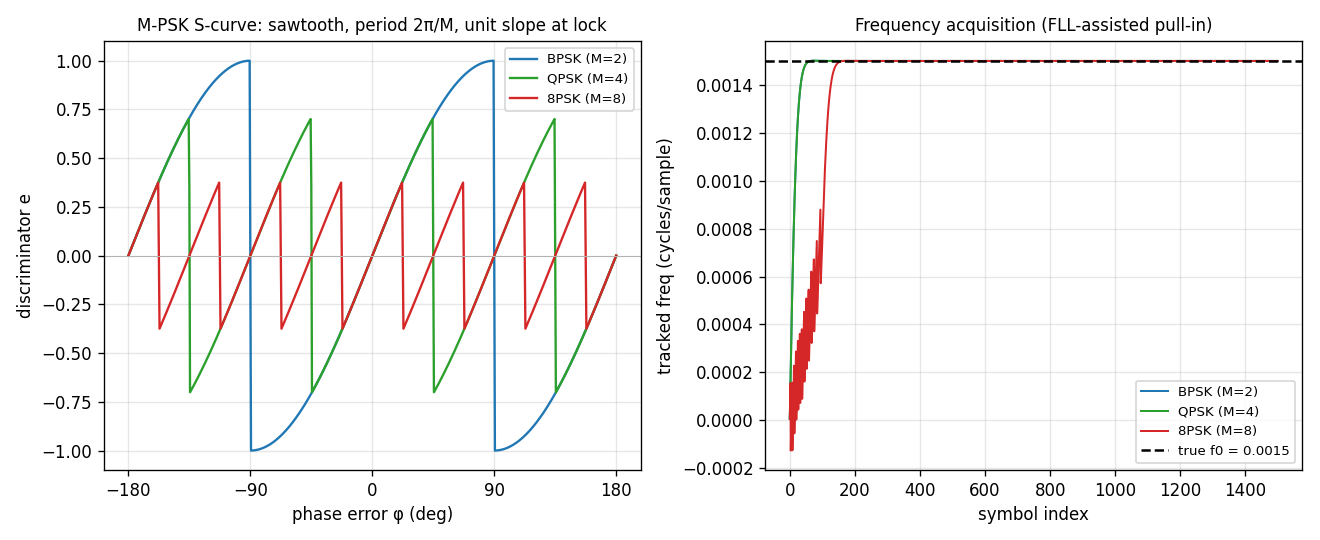
Left — Phase-detector S-curve. Driving the loop open-loop (bandwidth → 0)
with a noiseless constellation point rotated by a swept static phase error φ and
reading the discriminator traces a sawtooth of period 2π/M — the signature
of the M-fold phase ambiguity. While the decision is correct (|φ| < π/M) the
nearest point is the transmitted one, so e = sin(φ): a sine through the origin
with unit slope (Kd = 1) at lock. As φ crosses ±π/M the slicer jumps to the
adjacent point and e snaps to sin(φ ∓ 2π/M). Peak ±sin(π/M) (1.0 / 0.707 /
0.383 for M = 2 / 4 / 8). The measured curve matches the analytic sawtooth to
~8e-8 on the linear branches. At M = 2 it is exactly the BPSK Costas
S-curve.
Right — Frequency acquisition. A residual carrier step f0 = 0.0015
cycles/sample with the FLL assist (bn_fll = 0.01): the integer-NCO frequency
estimate per symbol converges onto the true offset (black dashed) for all three
orders. 8PSK pulls in more slowly and with more stress — its discriminator is
linear only over ±π/8, so the wide cross-product FLL does the heavy lifting
of dragging the frequency integrator on before the PLL refines phase. Without the
assist the bare 8PSK PLL would stall on this offset.
The M-fold ambiguity
The loop locks to one of M phases — it recovers the carrier but leaves a
k·2π/M rotation on the symbols. Resolve it downstream with differential
demapping (mpsk.mpsk_diff_demap) or a sync word; the
carrier loop itself stays modulation-data-agnostic and just emits the prompts.
import numpy as np

from doppler.mpsk import mpsk_map
from doppler.track import CarrierMpsk

# A QPSK signal at 16 samples/symbol carrying a residual carrier offset.
F0 = 0.0015  # residual carrier, cycles/sample
rng = np.random.default_rng(0)
labels = rng.integers(0, 4, 1500).astype(np.uint8)
tx = np.repeat(mpsk_map(labels, 4), 16).astype(np.complex64)
k = np.arange(tx.size)
rx = (tx * np.exp(2j * np.pi * F0 * k)).astype(np.complex64)

# QPSK carrier loop, 16 samples/symbol, FLL-assisted.
c = CarrierMpsk(
    bn=0.05, zeta=0.707, init_norm_freq=0.0, tsamps=16, bn_fll=0.01, m=4
)
symbols = c.steps(rx)  # one complex prompt per symbol
f_est = c.norm_freq  # tracked residual carrier (cycles/sample)
locked = c.lock_metric  # Re(P·conj â)/|P| EMA, ~1.0 when phase-locked
Rigorous bounds
Beyond the deterministic S-curve, the Monte-Carlo harnesses
native/validation/carrier_mpsk_scurve.c and carrier_mpsk_jitter.c (ctest
--check) prove, reading the loop's true NCO phase: closed-loop phase jitter
σ_φ² ≈ G·σ_disc² (G the analytic loop noise gain, proportional to bn); a
tracking threshold that tightens as M grows (BPSK still locked at 6 dB where
QPSK/8PSK have lost lock); and the FLL assist's frequency pull-in range exceeding
the bare PLL's, by ~2.5× for 8PSK.
Source: src/doppler/examples/mpsk_carrier_theory_demo.py; tests in
src/doppler/track/tests/test_theory_carrier_mpsk.py and the C harnesses above.