Detection Theory Curves¶
What you're seeing¶
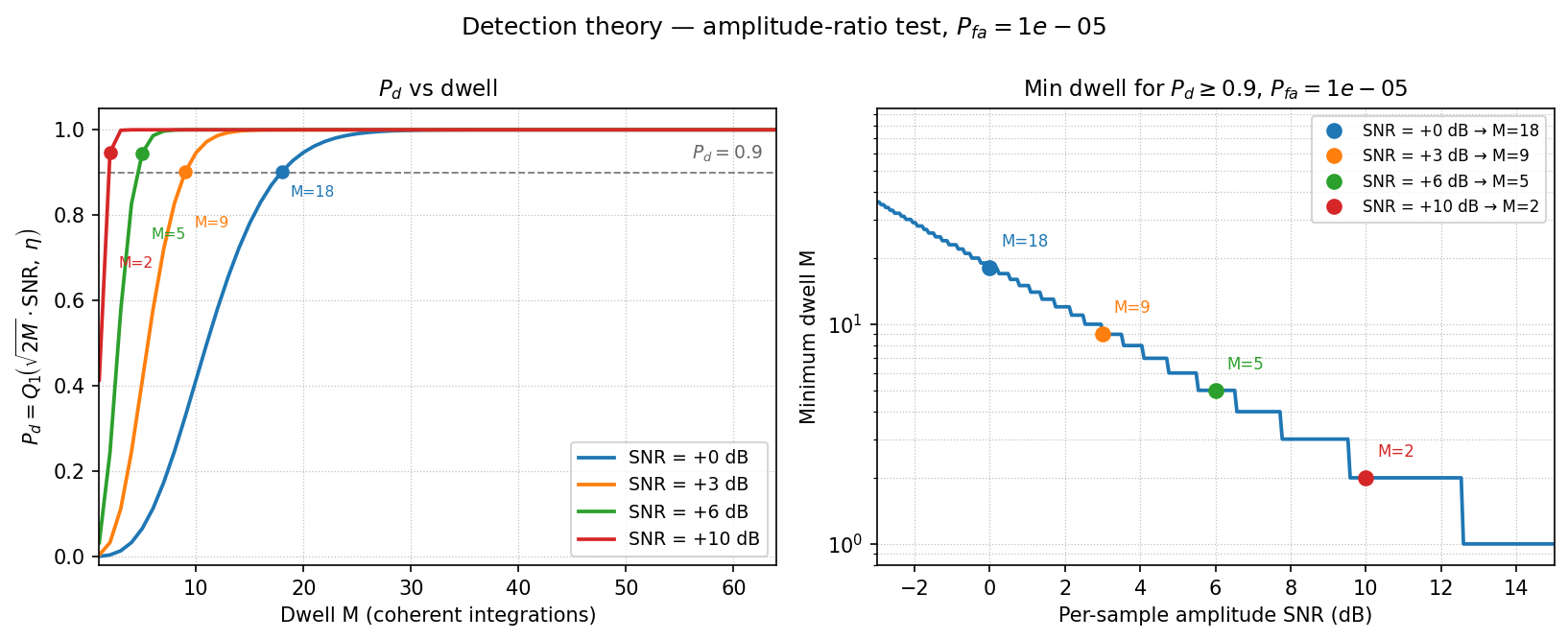
Left — Pd vs dwell M at Pfa = 1e-5, for SNR = 0, 3, 6, 10 dB. Curves shift left as SNR increases: more per-sample SNR trades against coherent integration depth. Filled circles mark where each curve first crosses Pd = 0.9 — M = 18, 9, 5, 2.
Middle — minimum dwell for Pd ≥ 0.9 vs SNR at fixed Pfa = 1e-5. Every 3 dB of extra SNR roughly halves the required dwell: at 0 dB you need 18 dwells for Pd = 0.9; at +6 dB you need only 5.
Right — what an estimated noise reference costs. The two panels
beside it price a statistic normalised by a known noise power. A
burst detector does not have one: it estimates the noise from the same
burst it is testing. That is not a flaw, it is what estimating means —
σ̂² = ΣIm²/n is σ²·χ²(n)/n, known to √(2/n), which is 35 % at
n = 16 — and the only question worth asking is how much margin to
budget for it.
The panel shows the two places that uncertainty can land. Gate as
though the reference were exact and it lands in the false-alarm
rate (red, left axis): 41× the rate you priced at n = 16. Gate with
det_threshold_f and it lands in the threshold instead (blue,
right axis), which is detection sensitivity in dB — 3.27 dB at n = 16,
about 1 dB at n = 100, and 6.15 dB if the false-alarm budget is 1e-6
rather than 1e-3. The dB is the number a link budget can use; a rate
multiplier is not.
Both curves are the same √(2/n) seen from two sides, so doubling the
prompts folded into the reference roughly halves the dB. The full
budget table, indexed by how many samples you can spare, is in
Detection Sizing §4 and is regenerated by the
certification rather than written down.
How it works¶
det_pd, det_dwell, and det_threshold implement the closed-form
Marcum Q functions. No simulation is needed to set a threshold or
predict performance:
import numpy as np

from doppler.detection import (
    det_dwell,
    det_pd,
    det_threshold,
    det_threshold_f,
    det_threshold_noncoherent,
)

PFA = 1e-5
PD_TARGET = 0.9
SNR_DB = [0, 3, 6, 10]  # curves for left panel
MAX_DWELL = 64
DWELL_X = np.arange(1, MAX_DWELL + 1)

ETA = det_threshold(PFA)  # threshold is Pfa-only; computed once

# Left panel: Pd vs dwell for each SNR.
snr_amps = [10 ** (db / 20) for db in SNR_DB]
pd_curves = [[det_pd(snr, int(d), ETA) for d in DWELL_X] for snr in snr_amps]

# Right panel: minimum dwell achieving Pd = 0.9 vs SNR from -3 to 15 dB.
snr_db_sweep = np.linspace(-3, 15, 300)
snr_amp_sweep = 10 ** (snr_db_sweep / 20)
min_dwell = [
    det_dwell(float(s), PD_TARGET, PFA, MAX_DWELL) for s in snr_amp_sweep
]

# Mask SNRs where det_dwell returned -1 (not achievable within MAX_DWELL).
valid = np.array(min_dwell)
mask = valid > 0

# Third panel: what an ESTIMATED noise reference costs.
#
# Every curve above prices a statistic normalised by a KNOWN noise power.
# A burst detector has one burst and must estimate the noise from it, so
# the exact H0 law becomes R^2 = n*F(n, n) -- a fatter tail than the
# chi-square gate prices. det_threshold_f is the exact gate; the penalty
# below is what using the chi-square one instead really delivers.
#
# The degrees of freedom are the trap, and the comparator is DERIVED
# rather than picked to match: under H0 the burst's n prompts give
# sum Re^2 ~ s^2*chi2(n), so a caller treating sum Im^2/n as exactly s^2
# believes R^2 ~ chi2(n) and gates at that quantile. Since
# det_threshold_noncoherent(pfa, M) prices chi2(2M), that is M = n/2.
# Pricing it at n gives 4.8x instead of 41x at n=16.
#
# EVEN n only -- n // 2 would price chi2(n-1) otherwise, which is the same
# gate as n-1 and overstates the penalty by about a fifth. doppler cannot
# express an odd-dof known-noise gate; det_threshold_f handles odd n
# deliberately, because a burst's prompt count is whatever it contained.
PFA_BURST = 1e-3
DOFS = [2, 4, 8, 16, 32, 64, 128]
assert all(n % 2 == 0 for n in DOFS)  # see the note above


def realized_pfa(quantile, n):
    """The pfa a given F(n,n) quantile really buys.

    det_threshold_f is monotone DECREASING in pfa, so bisect on the
    geometric mean of the bracket rather than inverting analytically.
    """
    lo, hi = 1e-15, 0.9999
    for _ in range(200):
        mid = float(np.sqrt(lo * hi))
        if det_threshold_f(mid, n) > quantile:
            lo = mid
        else:
            hi = mid
    return float(np.sqrt(lo * hi))


chi_gates = [
    det_threshold_noncoherent(PFA_BURST, max(n // 2, 1)) ** 2 / n for n in DOFS
]
f_gates = [det_threshold_f(PFA_BURST, n) for n in DOFS]
penalty = [realized_pfa(g, n) / PFA_BURST for g, n in zip(chi_gates, DOFS)]

# The TWO prices, and the estimate quality that causes both.
#
# `penalty` is a multiplier on the false-alarm RATE, paid by a detector
# that ignores the estimation. It is NOT "what an estimated reference
# costs" -- quoted as a cost it names no unit. The cost of doing it RIGHT
# is a higher threshold: detection sensitivity, in dB, which is the number
# a link budget wants.
#
# Both are the same sqrt(2/n) seen from two sides. sigma_hat^2 =
# sum Im^2 / n is sigma^2 * chi2(n)/n, whose relative standard deviation
# is sqrt(2/n) -- 35% at n=16. The floor the detector divides by is known
# only to a third, which is why the correct gate must sit so much higher.
sens_db = [10 * np.log10(f / g) for f, g in zip(f_gates, chi_gates)]
est_rel = [np.sqrt(2.0 / n) for n in DOFS]

# Self-checks: the theory functions must be internally consistent.
# Coherent integration only helps: Pd is non-decreasing in dwell.
for snr_db, pds in zip(SNR_DB, pd_curves):
    assert np.all(np.diff(pds) >= -1e-12), (
        f"Pd not monotone in dwell at {snr_db} dB"
    )

# det_dwell() must return the *minimum* dwell: Pd first crosses the
# target at M, i.e. Pd(M) >= target and Pd(M-1) < target.
for snr_db, snr_amp in zip(SNR_DB, snr_amps):
    m = det_dwell(snr_amp, PD_TARGET, PFA, MAX_DWELL)
    assert m > 0, f"Pd={PD_TARGET} unreachable at {snr_db} dB"
    assert det_pd(snr_amp, m, ETA) >= PD_TARGET, "det_dwell undershoots"
    assert m == 1 or det_pd(snr_amp, m - 1, ETA) < PD_TARGET, (
        "det_dwell is not minimal"
    )
    print(f"SNR {snr_db:+3d} dB: minimum dwell M = {m}")

# Integration gain compensates SNR: a stronger signal never needs a
# longer dwell, so the right-panel curve is non-increasing.
assert np.all(np.diff(valid[mask]) <= 0), "min dwell not monotone in SNR"

# The estimated-noise penalty is real, large, and shrinks as the estimate
# hardens. 41x at n=16 is the number detection_core.h quotes and the
# certification re-derives two independent ways (analytically here, and
# by 2e6 Monte-Carlo draws in the models characterization).
assert all(f > g for f, g in zip(f_gates, chi_gates)), (
    "the F gate must always be the stricter one"
)
assert abs(penalty[DOFS.index(16)] - 41.0) < 1.0, (
    f"penalty at n=16 is {penalty[DOFS.index(16)]:.1f}x, expected ~41x"
)
assert all(a > b for a, b in zip(penalty, penalty[1:])), (
    "the penalty must shrink monotonically as the noise estimate hardens"
)
assert penalty[-1] > 5.0, (
    "even at n=128 the chi-square gate is still materially mispriced"
)

# Price two: doing it correctly costs SENSITIVITY, not false alarms.
i16 = DOFS.index(16)
assert abs(sens_db[i16] - 3.27) < 0.05, (
    f"the correct gate costs {sens_db[i16]:.2f} dB at n=16, expected 3.27"
)
assert all(a > b for a, b in zip(sens_db, sens_db[1:])), (
    "more prompts in the reference must cost less sensitivity"
)
# Doubling n tightens sqrt(2/n) by sqrt(2) and roughly halves the dB cost.
assert all(0.4 < b / a < 0.75 for a, b in zip(sens_db, sens_db[1:])), (
    "the dB cost should roughly halve per doubling of n"
)
assert abs(est_rel[i16] - 0.3536) < 1e-3, "sqrt(2/16) is 35.4%"

for n, pen, db, rel in zip(DOFS, penalty, sens_db, est_rel):
    print(
        f"n={n:<4} noise known to {rel * 100:5.1f}%  ->  "
        f"ignore it: {pen:5.1f}x the priced pfa   |   "
        f"price it: {db:5.2f} dB of sensitivity"
    )
det_threshold inverts the Rayleigh CDF at Pfa to get the CFAR
gate eta. det_dwell binary-searches over M until
det_pd(snr, M, eta) >= pd_target.
See Monte Carlo vs Marcum Q for the 30,000-trial
validation of these closed-form curves against the envelope and power
detectors, Detection Sizing for why five
different laws ship under one det_ prefix and what happens when they
are crossed, and the
certification report
for the certified envelope these curves sit inside.