A 5-Burst DSSS Link — wfmgen's Three Faces, the Full Receiver Chain
Two things in one example: exercise every way wfmgen can produce a
waveform against the same declarative scene, then run the resulting
capture through all three receiver objects — BurstAcquisition,
BurstDespreader, BurstDemod — each demonstrated on its own before
they're chained, with every downstream stage seeded from what BurstAcquisition
actually finds, not from ground truth.
The scenario
5 bursts, each [ 5x511-chip unmodulated preamble | 1000-symbol BPSK payload spread 63 chips/symbol ], payload Es/N0 = 10 dB, separated by a
variable (burst-to-burst distinct) inter-burst gap. The payload frame is
sync word | 1000 payload bits | CRC-16, spread by a second, short code
distinct from the preamble code — the same frame layout
BurstDemod's own test suite uses, just longer.
Each gap is an explicit, distinct sample count (not repeats=N's randomized
redraws) so every burst's ground truth position stays exactly known for
scoring below; gap_noise="off" pins the inter-burst floor to silence for
the same reason — the DSSS bursts guide
page shows the realistic variant with the AWGN floor running through gaps.
Generating the capture — three faces, one scene
wfmgen is one C engine reachable three ways: the CLI binary, the
Composer.from_file Python binding loading the identical JSON scene, and
the Composer/Segment object API built with no JSON at all. Each burst is
one declarative type="dsss" segment — the engine tiles the preamble,
XOR-spreads the sync | payload | CRC-16 frame with the second code, sizes
the segment to exactly one burst, and interprets snr_mode="esno" as the
payload data-symbol Es/N0 (see the
waveforms guide).
All three faces should produce byte-identical samples for the same scene —
and here that's not just documentation, it's an assertion:
import tempfile

from doppler.examples.dsss_burst_pipeline_demo import (
    generate_waveform,
    burst_starts,
)

with tempfile.TemporaryDirectory() as tmp:
    rx, acq_code, data_code, payload_bits, frame_bits = generate_waveform(
        tmp
    )
starts = burst_starts()
len(rx), len(starts)
generate_waveform raises if any two faces diverge — reaching the return
value means the CLI, Composer.from_file, and Composer([Segment(...)])
all agree, bit for bit, on this multi-segment DSSS scene.
BurstAcquisition — alone, and actually blind
BurstAcquisition's real job is running continuously against a channel that's
mostly silence and noise, finding a signal (or not) with zero prior
knowledge of its timing — so this section runs it that way: ONE instance,
swept blindly across the entire capture:
from doppler.examples.dsss_burst_pipeline_demo import demo_acquisition

hits, acq = demo_acquisition(rx, acq_code)
len(hits)
Every one of the 5 real bursts is detected at Doppler bin 0 (no Doppler was
injected in this scene), purely from CFAR threshold crossings — no ground
truth passed in. Four land at exactly their true sample position; one lands
a whole number of code periods off. A detection's code phase is a lag modulo
one code period, so it never says which repetition the burst started in;
this hand-wired pipeline takes the first, and resolving the repetition is
what BurstCapture (and DsssBurstReceiver,
which composes it) adds. The engine is also constructed below its design
point here and warns that it is under-powered. A false alarm or two in the
noise-only regions typically also show up; see API notes for
why, and how the pipeline handles them.
How push() actually buffers and frames samples
Worth walking through in full, since it's why the sweep above is written
the way it is (acq_push in native/src/acq/acq_core.c):
- It's a ring-buffer FIFO, not an accumulate-then-process call. Each
call writes as many input samples as currently fit, drains every
complete
n = doppler_bins * code_bins-sample frame available (one 2-D FFT + PN correlate + CFAR test per frame), and loops write/drain until the input is consumed — so one call can hand it far more than the ring's own capacity. - Leftover samples short of a full frame stay buffered across calls —
unless a single call already hit the hardcoded, non-configurable
64-result cap (
native/src/acquire/acquire_ext_burst_acq.c, not exposed as a Python parameter), in which case the remaining input for that call is genuinely dropped, not buffered. Not a concern at realistic CFAR settings, but a real edge case worth knowing about. - Framing is strictly sequential and non-overlapping: one dwell is
always exactly one frame's worth of samples, in order, with no
sliding/search built into the primitive. A real burst's start is
essentially arbitrary relative to a fixed dwell grid, so
non-overlapping dwells will occasionally split a preamble across two
dwells and miss it. Overlap is the caller's job — this demo
reset()s the ring + accumulator between dwells at a hop 1/4 of a dwell width (75% overlap), sincepush()has no "restart the search here instead" concept of its own.
BurstDespreader — alone
Seeded from the matching discovered hit (Doppler bin → Hz via
doppler_res_hz; the absolute sample position already resolved the code
phase, so init_chip_phase=0.0), set_acq pulls the Costas/DLL loops in
across the preamble, then steps() despreads the frame to soft symbols:
from doppler.examples.dsss_burst_pipeline_demo import demo_despreader

results = demo_despreader(rx, hits, acq, acq_code, data_code, frame_bits)
[r["esn0_db"] for r in results]  # data-aided Es/N0 (dB), per detection
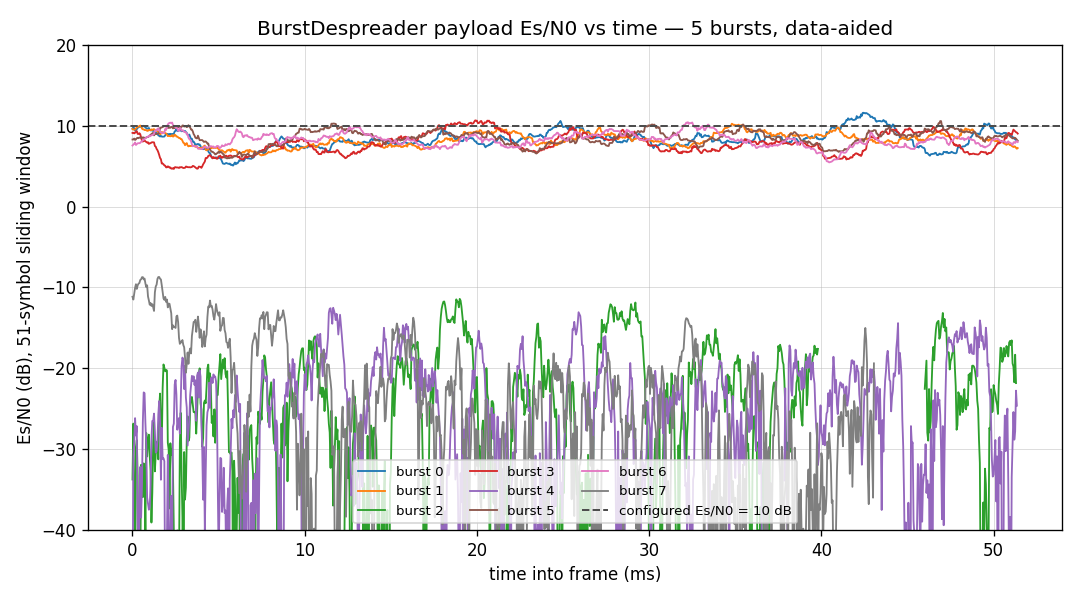
Bit errors land near zero and the measured Es/N0 lands within a couple dB of the configured 10 dB on every real burst found at its true start — the tracking loop follows the carrier and code phase continuously across all 1029 frame symbols. Any false alarms score wildly wrong Es/N0 and near-zero lock, exactly as they should.
Es/N0 (dB), not snr_est — now a standalone doppler.snr module
BurstDespreader's own snr_est isn't useful here (see
API notes), so this demo reports a data-aided Es/N0 (dB)
instead, from the standalone doppler.snr module:
strip the known modulation (z = soft * sign), and Es/N0 (linear) = signal
energy over complex noise variance = a**2 / mean(|z - a|**2) where
a = mean(Re(z)) — the same convention wfm_awgn_amplitude/add_noise()
use elsewhere in this repo. It's scale-invariant (works regardless of
BurstDespreader's internal symbol normalization) and polarity-invariant
(a**2 doesn't care whether a is + or −), so unlike the bit-error count
it needs no resolution of the sign ambiguity. doppler.snr also has a
non-data-aided sibling, snr_m2m4_db() (moment-based/M2M4, Pauluzzi &
Beaulieu 2000 — needs no known symbols at all, for any constant-modulus
signal), both with sliding-window _series counterparts.
A single scalar per burst hides the interesting part, though: a sliding 51-symbol window of the same estimate, plotted against time into the frame, is the hero image above. It shows what a table can't — tracking-loop settling right after the preamble hand-off, and any mid-frame dip (the DLL boundary slip noted below shows up as exactly that on burst 0).
BurstDemod — full pipeline
BurstDemod is a one-shot feedforward design: estimate (freq, rate),
dechirp once, despread, frame-sync, check the CRC-16. No tracking loop —
also seeded from the discovered hit, not ground truth:
from doppler.examples.dsss_burst_pipeline_demo import demo_burst_demod

demod_results = demo_burst_demod(
    rx, hits, acq, acq_code, data_code, payload_bits
)
sum(1 for valid, _errs in demod_results if valid), len(demod_results)
Every burst found at its true start decodes; false alarms and the aliased detection fail the CRC, as they should.
API notes
-
BurstAcquisition.push()'s buffering/framing is a ring-buffer FIFO with non-overlapping frames and a hardcoded 64-result-per-call cap — see Howpush()actually buffers and frames samples above for the full walkthrough. The short version: leftover samples persist across calls (good), but a call that hits the 64-result cap drops its remaining input (edge case), and achieving search overlap across dwells is entirely the caller's responsibility (not a knob on the object). -
Pfa stays correctly calibrated under a blind, overlapping-dwell sweep like this demo's, validated by a large Monte-Carlo sweep (the
burst_acquisitioncharacterization subject'smeasure_sweep_pfa) across several overlap fractions: overlapping search does not inflate the false-alarm rate beyond the configuredpfa. -
BurstDespreaderhas no absolute phase reference. The Costas loop locks to a line, not a point, so its raw hard bits can come out globally inverted. Resolving that sign is exactly whatBurstDemod's sync-word correlation (or a hand-rolled equivalent) is for —BurstDespreaderalone cannot do it, which is why the demo above scores both polarities. -
BurstDespreader.bits()/.steps()don't always emit exactlylen(x) // (sf*sps)symbols for an exact-multiple input. Under realistic noise the DLL's code-tracking jitter can slip the integrate-and-dump boundary by one symbol over a long (1000+ symbol) frame. Genuine streaming behaviour, not a bug — but downstream code must not assume the output length is exact. -
BurstAcquisition.push()'scn0_dbhz_esttracks true C/N0 while AWGN dominates the CFAR noise estimate, and saturates at the code's own autocorrelation-sidelobe floor once C/N0 exceeds what the code/geometry can resolve — a real ceiling, not a bug. -
BurstDespreader.snr_estis numerically unstable once the Costas loop is well locked on BPSK, and isn't dB either — an EMA ofRe(prompt)^2 / Im(prompt)^2. A locked BPSK prompt hasIm -> 0, so the ratio can spike to absurd values. Treat it as a rough lock-quality signal, not a calibrated SNR — this demo reports a proper data-aided Es/N0 (dB) instead. -
BurstDemodis one-shot feedforward (no tracking loop): one static(f0, mu)dechirp covers the whole payload, so its chirp-rate refinement matters. APolynomialPhaseEstimatorpass over the despread payload (a baseline ~20x longer than the preamble) NDA-refines both the rate and the residual frequency, applying both corrections regardless of whether a nonzero rate hypothesis was requested. At this demo's scale (1000-symbol payload, Es/N0=10 dB) that residual-frequency correction is what keeps the CRC passing on every real burst.BurstDespreader's continuous tracking loop never needed this: it doesn't need a good feedforward estimate, it converges to one.
Reproduce
Source: src/doppler/examples/dsss_burst_pipeline_demo.py. Integration
tests (skipped when the wfmgen CLI isn't built):
src/doppler/dsss/tests/test_burst_pipeline_demo.py.
See also
- DSSS Acquisition: Pd/Pfa — how
BurstAcquisition's detection performance is characterised against Es/N0. - wfmgen — One Engine, Every Waveform — the CLI and Composer API this example's generation step exercises.
- Python: Acquire — the full
BurstAcquisitionreference; Python: DSSS —BurstDespreader/BurstDemod.