Streaming Async Despreader¶
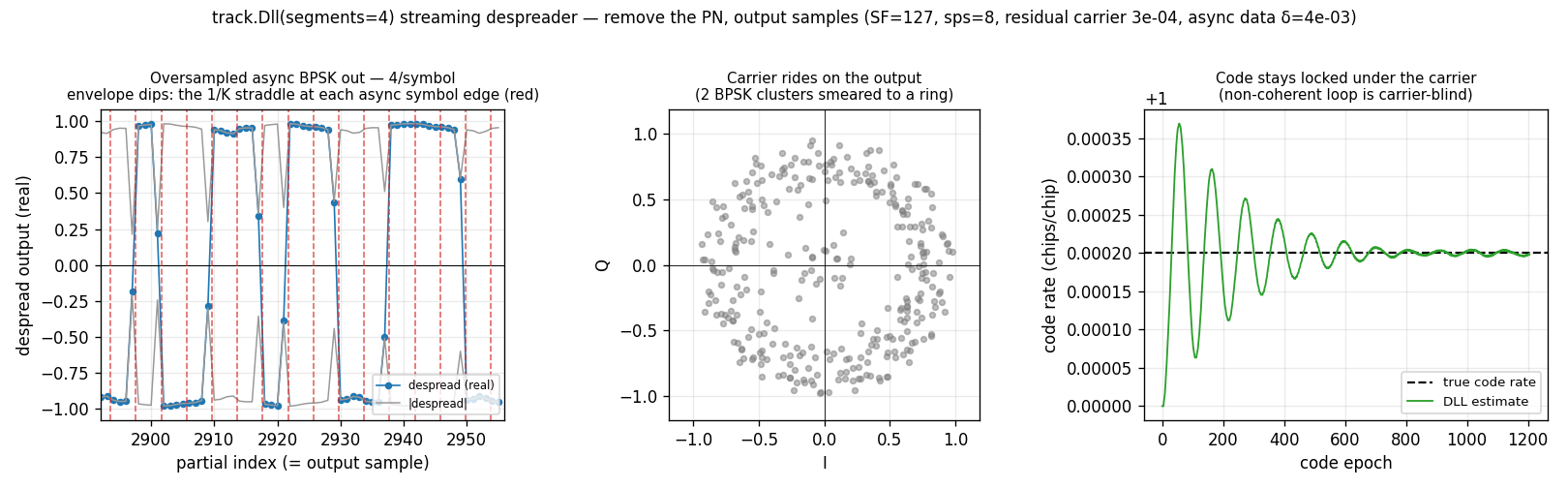
A track.Dll with segments > 1 is the despreader of
a DSSS link whose data clock is asynchronous to its code. It takes a
carrier-wiped stream, removes the spreading code, and emits segments despread
samples per code period. Those samples carry the symbol clock to the next stage,
a symbol-timing loop.
Two things make the asynchronous case different:
- A data transition lands in most code periods. Summed coherently across a transition, a period's correlation cancels. So the loop splits each period into partials and steers on the one-period window its look-back finds free of a transition.
- The code clock is dilated by the same motion that shifts the carrier. A
carrier offset
fon a carrierfcis a code-rate ratiof/fc. The carrier estimate that wipes the carrier, divided byfc, is also the code-rate aid,Dll.set_rate_aid. Aided, the loop carries only what the estimate missed, so it can stay narrow.
The setup is CCSDS Gold-1023 at 3.069 Mcps, asynchronous BPSK at 2700 bps, two samples per chip, at 10 dB Es/N0. The page runs the link twice, unaided and aided, at two Dopplers:
- 0.6 ppm, this link's Doppler: a 1500 Hz carrier offset on a 2.5 GHz carrier, which dilates the code by 1.8 chips/s.
- 5 ppm, inflated to about eight times this link's, 15 chips/s, to show what the aid is for.
What the runs show¶
- At this link's Doppler, both loops hold lock. Unaided, the loop filter output settles at the dilation, read up to one NCO step high (below): the loop carries it. Aided, it settles at zero, read the same way, because the aid carries it.
- At the inflated Doppler, only the aided loop holds. Unaided, the narrow loop must pull in the whole dilation, and the transient takes it off the code within tens of milliseconds. Its lock statistic falls to the noise and stays there. Aided, nothing changes from the 0.6 ppm run.
- The filter output reads high by up to one NCO step. The code NCO commands
its rate in whole phase-increment steps of
SF·spc/2³²chips per chip, 0.48 ppm here, and truncates. A settled filter output therefore sits between the rate the loop carries and one step above it. At this link's Doppler one step is nearly the whole Doppler, so the code loop's rate is not how to measure the Doppler. The carrier estimate is. - The output is the data. A locked loop emits the data symbols along one
axis, four samples per code period and 4.44 per symbol, so each symbol's
sign spans four or five samples. Its power along that axis stands above its
power across it by up to the link budget's
1 + 2·SNRper output sample. It reads below the budget because a sample straddling a data flip loses amplitude. The loop that lost the code puts out noise, with the two about equal.
The script prints this run's numbers: the settled filter outputs, when the unaided loop lost the inflated Doppler, and the output's power along its axis against across it. That ratio is the eigenvalues of the output's I/Q second moments, so it does not depend on the carrier phase. Three bounds come from the object and the link, not the draw: the output rate; the settled filter output sitting between the carried rate and one NCO step above it; and the output's power along one axis. The script widens the second by a quarter step either side for the noise left in its mean, and takes half the budget as the line for the third. Which loops held lock is this run's outcome, and the script asserts it for this run.
How it works¶
The emitter is wfm.Synth in continuous DSSS mode,
on nominal frequency, with its own PRBS payload.
impairment.DopplerChannel applies the motion
from one parameter: it dilates every clock in the stream and shifts the carrier
to match. The noise is source.AWGN at the Es/N0.
import numpy as np

from doppler.detection import (
    det_cn0_to_snr,
    det_n_noncoh,
    det_threshold_noncoherent,
    det_verify_count,
)
from doppler.impairment import DopplerChannel
from doppler.source import AWGN, LO
from doppler.track import Dll
from doppler.wfm import Gold, Synth, wfm_awgn_amplitude

# ── Setup: this scenario's numbers ─────────────────────────────────────────
SF = 1023  # Gold code period, chips (CCSDS)
CHIP_RATE = 3.069e6  # chips per second
SPC = 2  # samples per chip
FS = CHIP_RATE * SPC  # sample rate, 6.138 MSa/s
SYM_RATE = 2700.0  # BPSK symbols per second, asynchronous to the code
TE = SF * SPC  # one code period, samples: one push
EPOCH_S = TE / FS  # seconds of signal per push
CARRIER_HZ = 2.5e9  # the RF carrier the motion shifts
CARRIER_OFFSET_HZ = 1500.0  # this link's carrier offset
LINK_PPM = 1e6 * CARRIER_OFFSET_HZ / CARRIER_HZ  # the same motion: 0.6 ppm
INFLATED_PPM = 5.0  # inflated, to show what the aid is for
ESN0_DB = 10.0  # Es/N0 at the receiver input
CN0_DBHZ = ESN0_DB + 10.0 * np.log10(SYM_RATE)  # C/N0, dB-Hz
DURATION_S = 0.6  # seconds of signal per run

GOLD = np.asarray(Gold().generate(SF), np.uint8)

#: The code NCO's rate step, chips per chip: one phase increment of its
#: 32-bit accumulator, which turns once per code period.
NCO_STEP = TE / 2**32


def receive(doppler_ppm, seed=2):
    """The link at a Doppler: the emitter through a channel, then noise.

    The emitter is :class:`~doppler.wfm.Synth` in continuous DSSS mode on
    nominal frequency, with its own PRBS payload. The
    :class:`~doppler.impairment.DopplerChannel` applies the motion: it
    dilates every clock in the stream by ``1 + doppler_ppm * 1e-6`` and
    shifts the carrier by ``CARRIER_HZ * doppler_ppm * 1e-6``, from the one
    parameter. The noise is :class:`~doppler.source.AWGN` at the Es/N0.

    Returns
    -------
    x : NDArray[np.complex64]
        The received stream.
    channel : DopplerChannel
        The channel. Its ``offset_hz`` stands in for the carrier estimate an
        upstream carrier loop hands over, and its ``delay_samples`` for the
        code phase acquisition hands over.
    """
    n = int(DURATION_S / EPOCH_S) * TE
    tx = np.asarray(
        Synth(
            type="dsss",
            fs=FS,
            sps=SPC,
            data_code=GOLD.tobytes(),
            symbol_rate=SYM_RATE,
        ).steps(n),
        np.complex64,
    )
    channel = DopplerChannel(
        fs=FS, carrier_hz=CARRIER_HZ, doppler_ppm=doppler_ppm
    )
    # The channel takes at most 65536 samples a call.
    rx = np.concatenate(
        [channel.execute(tx[i : i + 65536]) for i in range(0, n, 65536)]
    )
    amp = float(
        wfm_awgn_amplitude(ESN0_DB - 10.0 * np.log10(FS / SYM_RATE), 1.0)
    )
    noise = AWGN(seed=seed, amplitude=amp).generate(len(rx))
    return (rx + noise).astype(np.complex64), channel
The despreader is configured for the link. bn is narrow, for a quiet code
phase. The lock detector is sized the way AsyncDsssReceiver sizes its own:
given the symbol period, its looks are coherent over the transition-free part of
a symbol, det_n_noncoh gives the looks a decision needs for 0.99 detection at
the C/N0, and det_verify_count gives the drop count. At its defaults, one
look per despread sample, the flag drops on a loop that holds the code:
measured on the receiver, a few times a second at Es/N0 10.7 dB and 96% of the
time at 5.7 dB
(§12.3).
One carrier estimate wipes the carrier and, divided by the carrier frequency, is
the rate aid. The loop starts at the code phase acquisition reports, to one
sample. The channel delays the stream by 10.5 samples, which is 5.25 chips at two
samples per chip. The code phase runs opposite to the delay, so the loop starts
at SF − 5 and pulls in the last quarter chip. That pull-in is the first couple
of hundred milliseconds in the filter-output panels.
BN = 0.002  # narrow, for a quiet code phase: what the aid lets the loop keep
SEGMENTS = (
    4  # despread samples per code period, for an asynchronous data clock
)
PFA = 1e-3  # the lock detector's false-alarm rate per decision
PD = 0.99  # its detection rate per decision, at the link's C/N0

# One row per push, read from the loop's own properties.
ROW = np.dtype(
    [
        ("locked", bool),
        ("lock_stat", float),
        ("filter_out", float),
        ("samples", int),
    ]
)


def despreader(init_chip):
    """A Dll for this link, its lock detector sized for the link.

    Given the symbol period, the detector's looks are coherent over the
    transition-free part of a symbol rather than one despread sample.
    ``det_n_noncoh`` gives the looks a decision needs for ``PD`` at the C/N0,
    and ``det_verify_count`` the consecutive misses that hold false drops
    under 1e-6 per decision. ``AsyncDsssReceiver`` sizes its own the same
    way, because at its defaults, one look per despread sample, the flag
    drops on a loop that holds the code: measured on the receiver, a few
    times a second at Es/N0 10.7 dB and 96% of the time at 5.7 dB
    (``docs/design/async-dsss-receiver-measurements.md`` section 12.3).

    Returns the Dll and its lock threshold.
    """
    dll = Dll(GOLD, sps=SPC, init_chip=init_chip, bn=BN, segments=SEGMENTS)
    dll.set_symbol_period(SEGMENTS * CHIP_RATE / (SF * SYM_RATE))
    look = dll.symbol_window * (TE // SEGMENTS)  # samples per look
    n_looks = det_n_noncoh(det_cn0_to_snr(CN0_DBHZ, FS), look, PD, PFA, 4000)
    dll.configure_lock(PFA, n_looks)
    dll.set_lock_verify(
        det_verify_count(PFA, PFA * 1e-3), det_verify_count(1.0 - PD, 1e-6)
    )
    return dll, det_threshold_noncoherent(PFA, n_looks)


def track(x, channel, aided):
    """Wipe the carrier, then despread with a Dll, one code period per push.

    One carrier estimate does two jobs. It wipes the carrier, and divided by
    the carrier frequency it is the code-rate aid. The loop starts at the code
    phase acquisition reports, to one sample. The code phase runs opposite to
    the delay, so a code that arrives ``L`` chips late starts the loop at
    ``SF - L``.

    Returns one :data:`ROW` per push, the lock threshold, and the despread
    output: ``SEGMENTS`` samples per code period, the data with the code
    removed.
    """
    carrier_estimate_hz = channel.offset_hz
    wiped = x * LO(-carrier_estimate_hz / FS).steps(len(x))

    lag_chips = np.floor(channel.delay_samples) / SPC
    dll, threshold = despreader(SF - lag_chips)
    if aided:
        dll.set_rate_aid(carrier_estimate_hz / CARRIER_HZ)

    rows = np.zeros(len(wiped) // TE, ROW)
    output = []
    for k in range(len(rows)):
        despread = dll.steps(wiped[k * TE : (k + 1) * TE])
        output.append(despread)
        rows[k] = (
            dll.locked,
            dll.lock_stat,
            dll.code_rate - 1.0,  # the loop filter output, chips per chip
            len(despread),
        )
    return rows, threshold, np.concatenate(output)
The checks run on one row per code period, and on the despread output:
def check(runs, outputs):
    """Assert what the runs show, and return what this run measured.

    ``runs`` maps ``(doppler_ppm, aided)`` to a run's rows, and ``outputs``
    to its despread output.

    Three bounds come from the object and the link, not the draw. The
    despread output is ``SEGMENTS`` samples per code period. A locked loop's
    output is the data along one axis, at whatever carrier phase the data
    sits: its power along that axis stands above its power across it by up
    to the link budget's ``1 + 2 * SNR`` per output sample, and reads below
    it because a sample straddling a data flip loses amplitude. The check
    takes half the budget as the line, below which the output is
    noise. And the NCO truncates its
    command, so a locked loop's settled filter output reads between the rate
    the loop carries and one NCO step above it. The check widens that by a
    quarter step either side, an allowance for the noise left in a mean over
    the settled half that is not part of the bound. The rest describes this
    run: first lock within a generous 50 ms, which loops held lock, and when
    the unaided loop lost it.
    """
    ms = 1e3 * EPOCH_S
    got = {}
    first = {}
    for (ppm, aided), rows in runs.items():
        assert abs(rows["samples"].sum() - SEGMENTS * len(rows)) <= SEGMENTS, (
            "the despread output is not SEGMENTS samples per code period"
        )
        assert rows["locked"].any(), f"{ppm} ppm aided={aided}: never locked"
        first[ppm, aided] = int(np.argmax(rows["locked"]))
        assert first[ppm, aided] * ms < 50.0, (
            f"{ppm} ppm aided={aided}: first lock at "
            f"{first[ppm, aided] * ms:.0f} ms"
        )

    # This run: aided, the loop holds lock from its first lock at both
    # Dopplers; unaided it holds this link's, and loses the inflated one.
    for key in ((LINK_PPM, True), (INFLATED_PPM, True), (LINK_PPM, False)):
        assert runs[key]["locked"][first[key] :].all(), (
            f"this run: {key[0]} ppm aided={key[1]} lost lock"
        )
    unaided = runs[INFLATED_PPM, False]["locked"]
    assert not unaided[len(unaided) // 2 :].any(), (
        "this run: the unaided loop held the inflated Doppler"
    )
    got["inflated_unaided_lost_ms"] = (
        len(unaided) - int(np.argmax(unaided[::-1]))
    ) * ms

    # The output: the data along one axis while the loop holds the code,
    # noise once it has lost it. The two eigenvalues of the output's I/Q
    # second moments are its power along its strongest axis and across it,
    # whatever carrier phase the data sits at. Per output sample the SNR is
    # Es/N0 over the samples a symbol spans.
    per_symbol = SEGMENTS * CHIP_RATE / (SF * SYM_RATE)
    budget = 1.0 + 2.0 * 10.0 ** (ESN0_DB / 10.0) / per_symbol
    for (ppm, aided), out in outputs.items():
        settled = out[len(out) // 2 :]
        iq = np.stack([settled.real, settled.imag]).astype(np.float64)
        across, along = np.linalg.eigvalsh(iq @ iq.T / iq.shape[1])
        ratio = float(along / across)
        holds = (ppm, aided) != (INFLATED_PPM, False)
        assert (ratio > budget / 2) == holds, (
            f"{ppm} ppm aided={aided}: output power along its axis against "
            f"across it {ratio:.2f}, against the budget's {budget:.2f}"
        )
        got[f"{ppm}_{aided}_axis"] = ratio
    got["axis_budget"] = budget

    # Physical: a locked loop's settled filter output is the rate it carries,
    # read high by up to one NCO step. Unaided, the loop carries the
    # dilation. Aided, the aid carries it and the loop carries nothing.
    for ppm, aided in (
        (LINK_PPM, False),
        (LINK_PPM, True),
        (INFLATED_PPM, True),
    ):
        rows = runs[ppm, aided]
        carried = 0.0 if aided else ppm * 1e-6
        mean = float(rows["filter_out"][len(rows) // 2 :].mean())
        steps = (mean - carried) / NCO_STEP
        assert -0.25 <= steps <= 1.25, (
            f"{ppm} ppm aided={aided}: filter output {1e6 * mean:+.2f} ppm, "
            f"{steps:+.2f} NCO steps from the {1e6 * carried:.2f} ppm the "
            "loop carries"
        )
        got[f"{ppm}_{aided}_filter_ppm"] = 1e6 * mean
    return got
Reading it when it does not behave¶
Read locked first: the code loop's lock flag. Then read lock_stat, the
statistic the flag thresholds, and then code_rate − 1, the loop filter output.
A filter output that walks away while lock_stat falls is a loop asked to carry
more rate than its bandwidth allows: aid it, or widen bn. A lock_stat that
grazes the threshold on a loop whose filter output is steady is a detector sized
for a higher C/N0 than the link has.
What you're seeing¶
- Code lock statistic (left). Unaided in orange, aided in blue, against the lock threshold. At 0.6 ppm the two traces lie on top of each other. At 5 ppm the unaided statistic falls to the noise early in the run, and the aided one stays where it was at 0.6 ppm.
- Loop filter output (right),
code_rate − 1in ppm, per code period and as a 30 ms mean. The dashed line is the dilation. Each shaded band is where a loop reads when it carries its rate: from that rate to one NCO step above it, orange from the dilation and blue from zero. At 5 ppm the unaided output climbs toward the dilation, loses the code before it gets there, and wanders. - The despread output (bottom): about fourteen symbols of the aided loop's output at 0.6 ppm, from the settled half. I carries the data, in runs of four or five samples per symbol and longer where neighbors share a sign, and Q is noise about zero. The data lands on I only because this demo wipes the carrier with the channel's exact offset and the channel adds no carrier phase. With an estimated carrier, the data sits at whatever residual phase the estimate leaves, which the receiver's Costas loop ahead of the Dll is there to remove. This stream is what a symbol-timing loop takes next.
Reproduce¶
The C twin is
async_despread_demo.c.
It runs the same link at the same two Dopplers, with the same emitter, noise
seed and loop, and checks the same physics, so it prints the same numbers as
this page's run. It also shows what the binding hides: the emitter's and the
loop's full settings, and the buffers the caller owns.
The design is in the async DSSS receiver design,
section 3. The lock-detection guide covers how the
Dll's lock detector fits alongside every other loop's.
Source: async_despread_demo.py.