DSSS Acquisition & Despreading
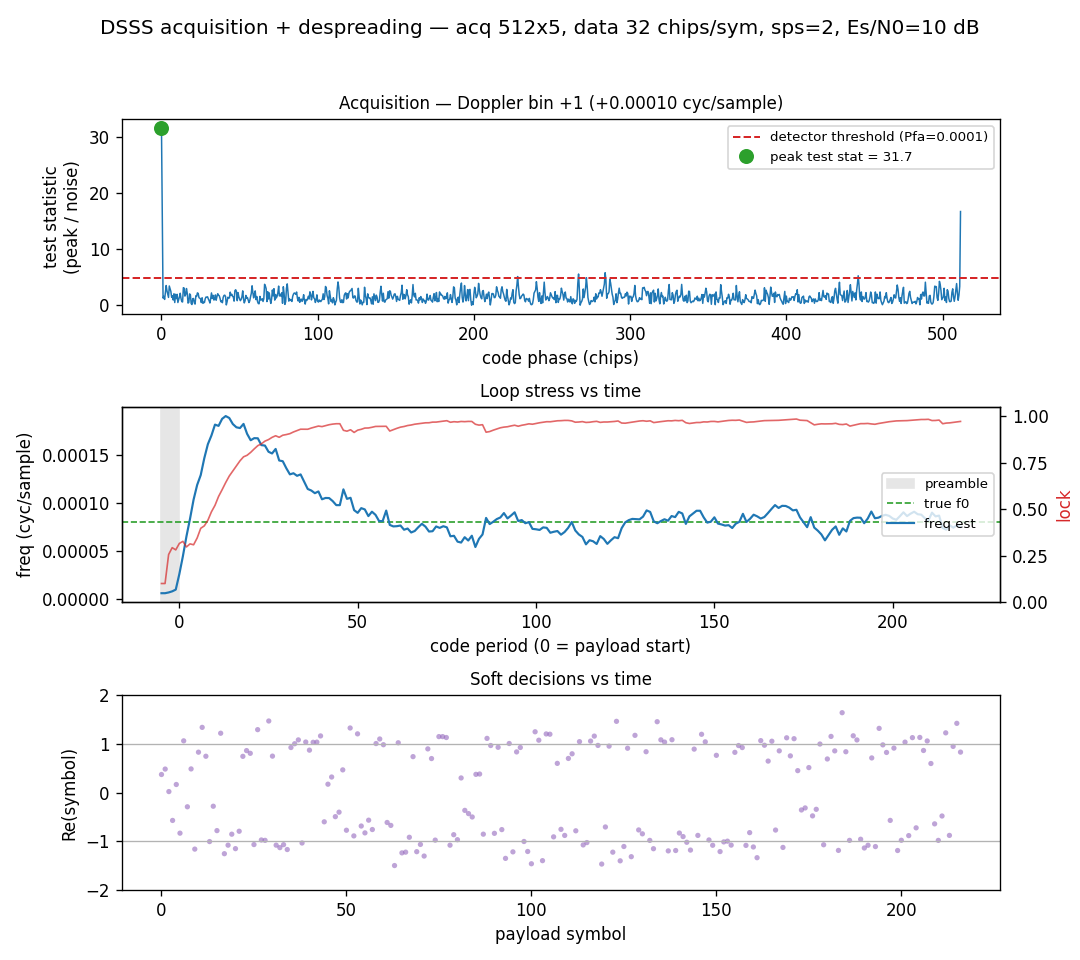
A complete direct-sequence spread-spectrum (DSSS) BPSK receiver: acquire the
burst, then track and despread it. The transmit burst is an acquisition
preamble — 5 repetitions of a long (512-chip) acquisition code, unmodulated —
followed by a payload spread by a distinct, shorter (32-chip) data code.
Es/N0 = 10 dB, with a residual carrier offset.
What you're seeing
Top — Acquisition. A 2-D (Doppler × code-phase) matched-filter search of the
preamble against the acquisition code, coherently summing the 5 periods, via
Corr. The plot is the test statistic (peak ÷ noise
estimate) across code phase at the winning Doppler bin. The sharp peak clears the
CFAR detector threshold (red dashed) from
det_threshold — the signal is declared present, and the
peak (Doppler bin, code phase) seeds the despreader.
Middle — Loop stress vs time. The carrier-frequency estimate (blue) pulling
onto the true offset (green dashed) while the lock metric (red) ramps to 1. The
preamble (shaded) is where set_acq pulls the loops in coherently — the
unmodulated repeated code gives a full ±π carrier discriminator — before the
payload begins.
Bottom — Soft decisions vs time. The complex prompt symbol's real part as dots, clustering on ±1 (a 180° flip is don't-care).
How it works
The receiver is built from two new objects:
track.LoopFilter— a reusable 2nd-order PI loop filter, the shared engine of the code and carrier loops.dsss.Despreader— carrier wipe-off (Costas) + an early/prompt/late delay-locked loop (DLL), integrate-and-dump per code period.
import numpy as np
from doppler.dsss import Despreader

# A real DSSS-BPSK payload: 40 symbols spread by a 32-chip data code at 2
# samples/chip, plus the long acq code that seeds the preamble pull-in.
rng = np.random.default_rng(0)
data_code = rng.integers(0, 2, 32).astype(np.uint8)
acq_code = rng.integers(0, 2, 512).astype(np.uint8)
dsig = np.where(data_code & 1, -1.0, 1.0)
syms = (rng.integers(0, 2, 40) * 2 - 1).astype(float)
rx = np.repeat(np.concatenate([s * dsig for s in syms]), 2).astype(
    np.complex64
)
acq_freq, acq_chip = 0.0, 0.0  # seeded from acquisition (genie here)

# seed from acquisition: norm_freq (cycles/sample), chip phase (chips)
d = Despreader(data_code, sf=32, sps=2,
               init_norm_freq=acq_freq, init_chip_phase=acq_chip)
d.set_acq(acq_code, acq_reps=5)    # preamble-aided pull-in (optional)
symbols = d.steps(rx)              # complex prompt symbols
bits    = d.bits(rx)              # or hard BPSK decisions
The despreader is seeded by acquisition and is transport-agnostic: its cf32
symbol output chains over the stream module's dp_header_t framing like any
other DSP block.
Source: src/doppler/examples/dsss_despread_demo.py.