Monte Carlo vs Marcum Q Theory
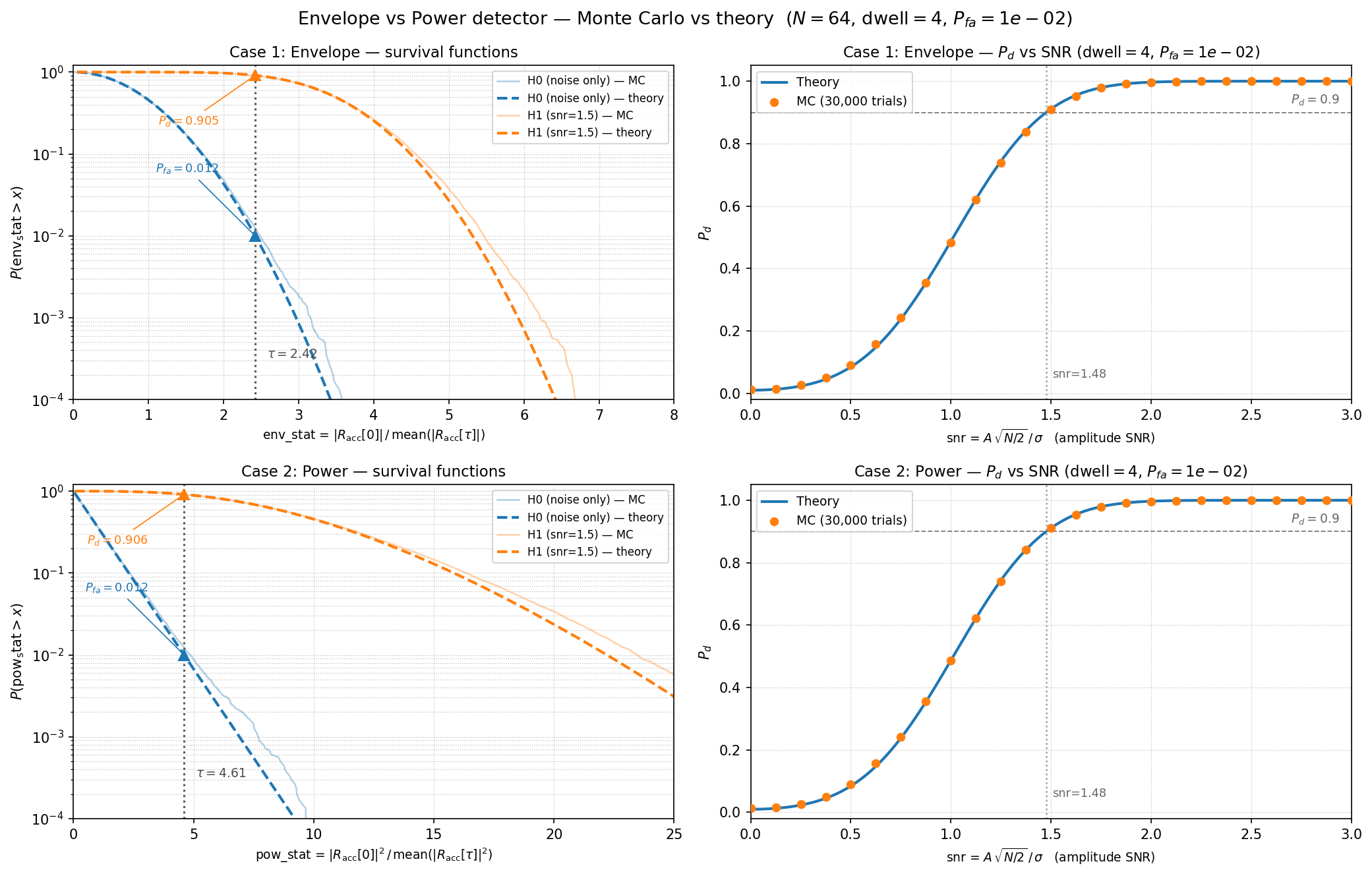
What you're seeing
Left — empirical survival functions vs closed-form curves. Each histogram is built from 30,000 independent trials per SNR point. The solid lines are the Rician (H1) and Rayleigh (H0) CDFs evaluated at the same parameters. Empirical and theoretical curves sit on top of each other throughout — no visible deviation.
Right — Pd vs SNR. Monte Carlo operating points (dots) track the Marcum Q prediction (solid line) within statistical noise at every tested SNR. The Pfa operating point is confirmed by the fraction of H0 trials that exceed the threshold.
How it works
The simulation draws matched-filter outputs directly from their theoretical distributions rather than running the full FFT pipeline:
- H0: envelope ~ Rayleigh(
σ) — noise-only hypothesis - H1: envelope ~ Rician(
ν,σ) — signal + noise
This avoids the degeneracy that appears when a single-bin tone is correlated against itself via FFT (the signal component is deterministic and the test statistic is not representative of the general case).
import math

import numpy as np

from doppler.detection import (
    det_pd,
    det_pd_power,
    det_threshold,
    det_threshold_power,
    marcum_q,
)

N = 64  # frame length (complex samples)
DWELL = 4  # coherent integrations
SIGMA = 1.0  # noise std dev per real/imag component
PFA = 1e-2  # false-alarm rate (moderate for MC statistics)
N_TRIALS = 30_000  # trials per SNR point
SNR_HIST = 1.5  # SNR used for the survival-function panels

# Envelope detector thresholds.
ETA = det_threshold(PFA)  # Q₁ argument
THETA = ETA * math.sqrt(2.0 / math.pi)  # env_stat threshold

# Power detector thresholds.
P_THRESH = det_threshold_power(PFA)  # pow_stat threshold = -ln(Pfa)

RNG = np.random.default_rng(0)


def simulate(snr: float, n_trials: int = N_TRIALS) -> tuple:
    """Run Monte Carlo trials and return both test statistics.

    Samples the matched-filter output and noise reference directly from
    their theoretical distributions.  The FFT cross-correlation of a
    single-bin tone with AWGN produces R[τ] = W·exp(j2πτ/N), making
    |R[τ]| identical at every lag — so both test statistics would be 1
    regardless of SNR.  Direct sampling avoids that degeneracy and is
    the canonical way to verify the Marcum Q model.

    After M coherent integrations:
    - Signal channel: R₀ ~ CN(M·A, 2·M·σ²/N)
    - Noise reference: N−1 i.i.d. samples from CN(0, 2·M·σ²/N)

    Parameters
    ----------
    snr : float
        Post-correlation amplitude SNR: snr = A·√(N/2)/σ.  Zero → H0.
    n_trials : int
        Number of independent trials.

    Returns
    -------
    env_stat : np.ndarray, shape (n_trials,)
        |R₀| / mean(|noise_ref|).
    pow_stat : np.ndarray, shape (n_trials,)
        |R₀|² / mean(|noise_ref|²).
    """
    A = snr * SIGMA * math.sqrt(2.0 / N)
    sig_amp = DWELL * A  # coherently accumulated
    sigma_ac = SIGMA * math.sqrt(DWELL / N)  # per-component std dev

    # Matched-filter output at lag 0: CN(sig_amp, 2·sigma_ac²).
    re0 = sig_amp + RNG.standard_normal(n_trials) * sigma_ac
    im0 = RNG.standard_normal(n_trials) * sigma_ac
    mag0 = np.hypot(re0, im0)

    # N−1 independent noise reference samples from CN(0, 2·sigma_ac²).
    re_n = RNG.standard_normal((n_trials, N - 1)) * sigma_ac
    im_n = RNG.standard_normal((n_trials, N - 1)) * sigma_ac
    mag_n = np.hypot(re_n, im_n)

    env_stat = mag0 / mag_n.mean(axis=1)
    pow_stat = mag0**2 / (mag_n**2).mean(axis=1)
    return env_stat, pow_stat


print(f"Running H0 ({N_TRIALS:,} trials)…")
env_h0, pow_h0 = simulate(0.0)

print(f"Running H1 snr={SNR_HIST} ({N_TRIALS:,} trials)…")
env_h1, pow_h1 = simulate(SNR_HIST)

snr_sweep = np.linspace(0.0, 3.0, 25)
print(f"Running Pd sweep ({len(snr_sweep)} SNR × {N_TRIALS:,} trials)…")
pd_env_mc = np.empty(len(snr_sweep))
pd_pow_mc = np.empty(len(snr_sweep))
for i, s in enumerate(snr_sweep):
    ev, pw = simulate(float(s))
    pd_env_mc[i] = (ev > THETA).mean()
    pd_pow_mc[i] = (pw > P_THRESH).mean()

pd_env_th = np.array([det_pd(float(s), DWELL, ETA) for s in snr_sweep])
pd_pow_th = np.array(
    [det_pd_power(float(s) ** 2, DWELL, P_THRESH) for s in snr_sweep]
)

print("Done.")

# Validate MC against theory.
# CFAR design point: both detectors' H0 exceedance rates must sit at
# the Pfa their thresholds were derived for (30k trials → MC sigma
# ≈ 6e-4, so ±50% of Pfa = 1e-2 is a generous band).
pfa_env_mc = float((env_h0 > THETA).mean())
pfa_pow_mc = float((pow_h0 > P_THRESH).mean())
print(f"Pfa: env = {pfa_env_mc:.4f}, pow = {pfa_pow_mc:.4f} (design {PFA})")
assert abs(pfa_env_mc - PFA) < 0.5 * PFA, "envelope Pfa off design point"
assert abs(pfa_pow_mc - PFA) < 0.5 * PFA, "power Pfa off design point"

# Marcum-Q Pd model: the MC sweep must track theory at every SNR.
err_env = float(np.max(np.abs(pd_env_mc - pd_env_th)))
err_pow = float(np.max(np.abs(pd_pow_mc - pd_pow_th)))
print(f"max |MC - theory| Pd: env = {err_env:.4f}, pow = {err_pow:.4f}")
assert err_env < 0.02, "envelope Pd deviates from Marcum-Q theory"
assert err_pow < 0.02, "power Pd deviates from Marcum-Q theory"
The Rician draw uses a single non-central Gaussian pair:
re0 ~ N(sig_amp, sigma_ac), im0 ~ N(0, sigma_ac). The envelope
hypot(re0, im0) is exactly Rician-distributed.
See Detection Theory Curves for the closed-form
det_pd / det_dwell / det_threshold reference and threshold
derivation.