AsyncDsssPool: the population's lifecycle
Where AsyncDsssReceiver: the SPEC Waveform
drives one packaged receiver against one emitter, this page drives the
object that holds the population: dsss.AsyncDsssPool
— one searcher, a pool of cell receivers created idle, the assigned table,
and the event log by attachment, all behind a single push().
Two emitters on one Gold code, told apart by Doppler and code phase
alone, arrive on one channel. One leaves the air and is released by the
receiver's own rule — both lock flags down, without a break, for longer
than the confirm interval; it returns and is a new detection into
whichever slot is free, because the pool remembers nothing about an
emitter it has released. The searcher's false alarms are part of that
lifecycle: at pfa 1e-3 a noise peak occasionally seeds a free slot, pulls
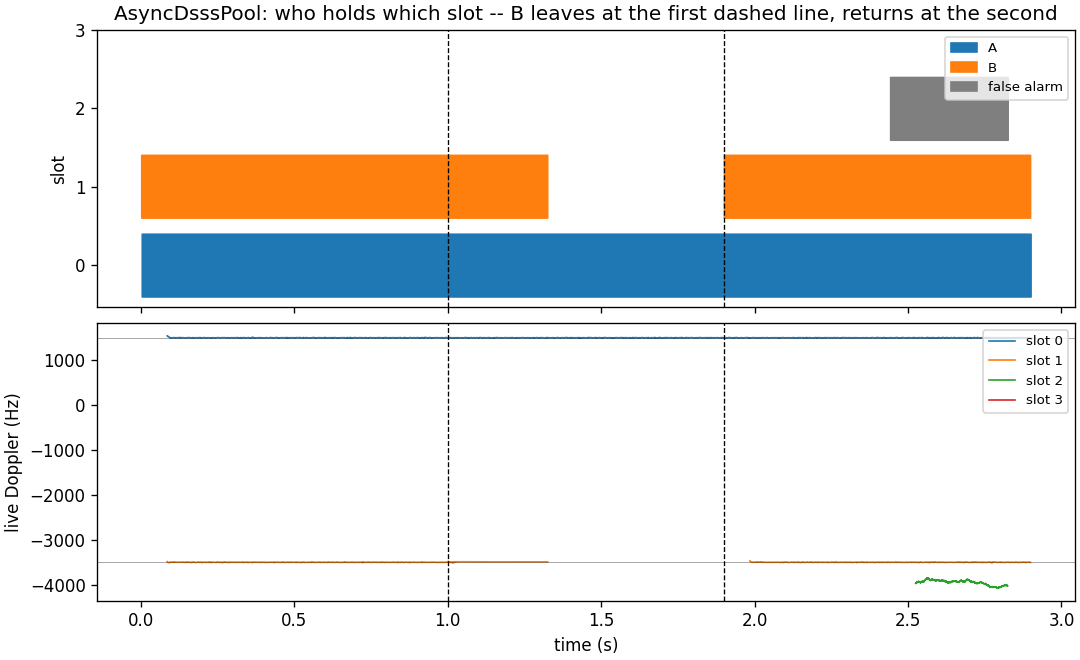
in to nothing, and is released one interval later. That is why the figure
colours them, and why a slot is an emitter's by both coordinates — its
seed within the searcher's row of the emitter's Doppler and within a chip
of its code phase — never by a count. The C twin,
native/examples/async_dsss_pool_demo.c, manages what the binding hides:
the symbol buffer sized after the first push, the borrowed log the caller
closes.
The geometry
The design's operating point at a demo's depth, D = 16: a 1023-chip Gold
code at 5 Mcps, two samples per chip, asynchronous BPSK at 2700 sym/s. The
searcher runs epoch by epoch over ±6 kHz, and coherence across D = 16
epochs makes its Doppler row 305 Hz wide, so the two emitters — 5 kHz apart
— are sixteen rows apart and two unmistakable peaks. Four slots and a
release interval of 300 ms keep the whole lifecycle inside one figure.
import numpy as np

from doppler.dsss import AsyncDsssPool
from doppler.telemetry import EventLog
from doppler.wfm import Gold, Synth, _SynthEngine, wfm_awgn_amplitude

SF = 1023
CHIP_RATE = 5.0e6
SPC = 2
FS = CHIP_RATE * SPC
SYM_RATE = 2700.0
TE = SF * SPC  # one code epoch, the push block
CN0_DBHZ = 47.0
DU = 6000.0  # the searcher's span: +-6 kHz
# The code-only window the searcher aligns its blocks inside: 20 symbols of
# every 270 (ten frames a second; the operating point's is 450 of 4950),
# holding the 31 whole epochs a depth of 16 needs at any chip phase -- rows
# of 305 Hz, inside the cell receivers' pull-in (the pool refuses a
# shallower searcher).
W_SYM, F_SYM, CODE_ONLY_EPOCHS = 20, 270, 31
LOST_S = 0.3  # the release interval, short enough to see
N_SLOTS = 4
EMITTERS = {  # name: (Doppler Hz, code phase at sample 0 in chips, seed)
    "A": (1500.0, 0, 1),
    "B": (-3500.0, 900, 2),
}
ON_S, OFF_S = 1.0, 3.0 * LOST_S  # A always on; B on, off, on
CODE = np.asarray(Gold().generate(SF)).astype(np.uint8)
The stimulus is the shipped waveform
Each emitter is the shipped continuous-DSSS Synth at its own carrier
offset, clean; the second starts 900 chips into its code (two emitters at
one code phase are one peak to the searcher, and one row to the pool's
zone); the noise is a type="noise" Synth scaled by
wfm_awgn_amplitude from the C/N0, added once at the sum. B's synth keeps
running while it is off the air — coming back is not restarting.
def emitter(doppler_hz: float, chip0: int, seed: int) -> _SynthEngine:
    """One emitter: the shipped continuous DSSS at a carrier offset, clean,
    with the waveform's code-only window, its code `chip0` chips in at the
    stream's first sample (a burn-in the caller discards) -- two emitters
    must differ in code phase as well as Doppler, since one phase is one
    peak to the searcher. The engine rather than ``Synth``: the window is
    the engine's alone (#1294)."""
    syn = _SynthEngine(
        type="dsss",
        fs=FS,
        freq=doppler_hz,
        snr=100.0,  # clean: the noise is added once, at the sum
        sps=SPC,
        seed=seed,
    )
    syn.set_dsss_cont(CODE, CHIP_RATE / SYM_RATE, data="prbs")
    syn.set_dsss_window(W_SYM, F_SYM)
    if chip0:
        syn.steps(chip0 * SPC)
    return syn


def stimulus(seed: int = 7):
    """Both emitters on for ON_S, B off for OFF_S (its synth keeps running:
    coming back is not restarting), both on again; noise at the sum.
    Returns the capture and B's on-air mask per epoch."""
    a = emitter(*EMITTERS["A"])
    b = emitter(*EMITTERS["B"])
    n_on, n_off = int(ON_S * FS / TE), int(OFF_S * FS / TE)
    on_b = np.array([1] * n_on + [0] * n_off + [1] * n_on, dtype=bool)
    blocks = []
    for on in on_b:
        sa = a.steps(TE)
        sb = b.steps(TE)
        blocks.append(sa + sb if on else sa)
    x = np.concatenate(blocks)
    # C/N0 referred to fs; the Synth emits unit total power, the amplitude
    # is per component, and the sqrt(2) bridges the two conventions.
    amp = float(wfm_awgn_amplitude(CN0_DBHZ - 10.0 * np.log10(FS), 1.0))
    noise = Synth(type="noise", fs=FS, seed=seed).steps(len(x))
    return (x + amp * np.sqrt(2.0) * noise).astype(np.complex64), on_b
The pool, and reading it back
One push() per epoch; after each, every slot's record by value
(status(slot)), the symbols it decided on this push (symbols(slot)),
and the owner of its seed against the truth.
def owner(pool: AsyncDsssPool, slot: int) -> str | None:
    """Which emitter a slot's SEED is -- row and chip phase -- or None
    for a false alarm (a noise seed at another phase)."""
    r = pool.status(slot)
    if not r.assigned:
        return None
    for name, (f, chip0, _) in EMITTERS.items():
        truth = (r.seed_sample / SPC + chip0) % SF
        dc = abs(r.seed_chip_phase - truth)
        dc = min(dc, SF - dc)
        if abs(r.seed_doppler_hz - f) <= pool.doppler_res_hz and dc <= 1.0:
            return name
    return "false alarm"


def run(x: np.ndarray, events_path: str):
    pool = AsyncDsssPool(
        CODE,
        chip_rate=CHIP_RATE,
        symbol_rate=SYM_RATE,
        spc=SPC,
        cn0_dbhz=CN0_DBHZ,
        pfa=1e-3,
        doppler_uncertainty=DU,
        code_only_epochs=CODE_ONLY_EPOCHS,
        n_slots=N_SLOTS,
        lost_confirm_s=LOST_S,
        threads=1,
    )
    log = EventLog(events_path)
    pool.set_event_log(log)
    n_ep = len(x) // TE
    who = np.full((N_SLOTS, n_ep), "", dtype=object)  # owner per epoch
    dopp = np.full((N_SLOTS, n_ep), np.nan)  # live Doppler while tracking
    n_syms = dict.fromkeys(EMITTERS, 0)
    for k in range(n_ep):
        pool.push(x[k * TE : (k + 1) * TE])
        for i in range(N_SLOTS):
            o = owner(pool, i)
            r = pool.status(i)
            who[i, k] = o or ""
            if o in n_syms:
                n_syms[o] += len(pool.symbols(i))
            if r.assigned and r.state == 2:  # tracking
                dopp[i, k] = r.doppler_hz
    pool.set_event_log(None)
    log.close()
    with open(events_path) as fh:
        events = [json.loads(line) for line in fh]
    assert len(events) == pool.events, "every transition reached the log"
    return who, dopp, n_syms, events
What the figure shows
The upper panel is occupancy — one horizontal band per slot, coloured by whose seed the slot holds. The lower panel is each tracked receiver's live Doppler, against thin lines at the two emitters' true offsets. The dashed verticals are the moments B leaves the air (1.0 s) and returns (1.9 s).
- A (blue) is seeded in the run's first epochs and holds slot 0 for the whole 2.9 s; in the lower panel its live Doppler sits flat on the +1500 Hz truth line.
- B (orange) holds slot 1 and keeps it for roughly a third of a second after it leaves — the release rule cannot fire before the 300 ms confirm interval, and here it fires just past it. When B returns, the pool has no memory of it: it is a fresh detection, seeded into whatever slot is free, which on this run is slot 1 again.
- The grey stint near 2.5 s is one of the searcher's false alarms. It takes the free slot 2, its receiver "tracks" noise at about −4000 Hz in the lower panel — nowhere near either truth line — and one release interval later the slot is free again. This is what the pool's slot headroom is for: the design's default of twelve slots carries ten emitters and the false alarms passing through them.
- The event log carries every transition — seeded, tracking, lost, released, seeded again, in order — and its line count equals what the pool counted.
The pool is certified at the full operating point, rather than this demo's,
by the lifecycle soak validate_async_dsss_pool_soak: ten emitters through
the channel at their own Dopplers, the block-coherent searcher at
D = 154, two minutes at 45 and 40 dB-Hz.
See also
- The async DSSS receiver design — the searcher, the cell receivers and the assignment rules the pool composes.