M-PSK Receiver — Pull-in, Lock, and BER¶
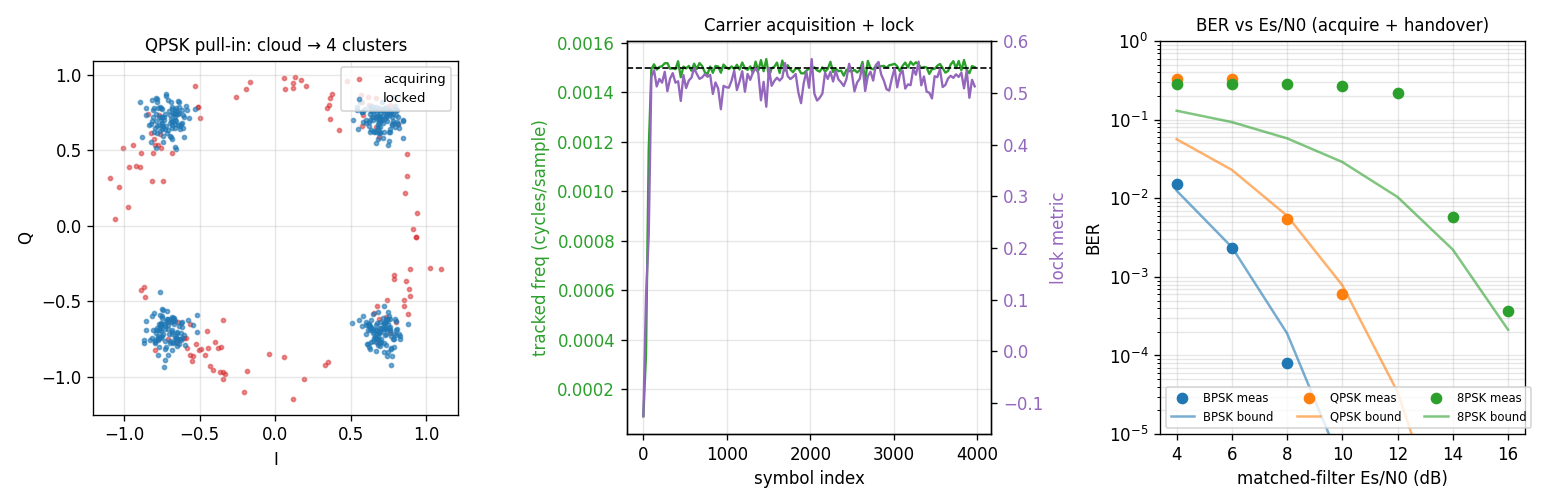
track.MpskReceiver is a complete M-PSK modem, and it
owns no filter, no NCO and no interpolator of its own. It is a matched
down-converter with two loops closed around its two control ports: a
MatchedDDC mixes, decimates and matched-filters in the dot
products it was already doing, a carrier loop steers its LO (freq_ctrl), and
RateSync's own timing loop steers its terminal accumulator
(rate_ctrl). The terminal polyphase stage's bank is the matched filter
(integrate-and-dump by default, or root-raised-cosine for band-limited links) and
the arm it selects is the fractional symbol-timing delay. Carrier recovery
follows the project rule, now structurally rather than by convention:
predetection de-rotation in the LO at the front of the chain, and
postdetection discrimination on the matched-filtered symbols at the end of
it. See the design note.
Because the front end plans its own cascade, sps is a double and an
irrational samples-per-symbol — a free-running ADC clock against the symbol clock
— is no harder than an integer one. The matched filter costs ~34 taps/arm at
sps = 8 and at sps = 256 alike, against the ~4225 taps/arm a single-stage
design would need at the top of that range.
track.MpskReceiverR is the real-input face: same
loops, same demapper — literally the same implementation — with a
MatchedDdcr front end so it takes a real IF (f32) instead of complex
baseband. It is a view over the same core, not a second type: steps() takes a
different dtype, which used to force a separate class and no longer does
(just-makeit#1012 lets a view bind its own C symbol under the parent's Python
name).
Left — Constellation pull-in. A QPSK signal with a 0.0015 cycles/sample
carrier offset, with the loop seeded at zero. During acquisition (red) the
de-rotated symbols sweep a ring — the residual carrier is still rotating them;
once the non-data-aided loop pulls the LO onto the offset, the symbols (blue)
collapse onto the four QPSK clusters. No data aiding is required to acquire —
that is what the M-th-power discriminator buys. Note that the old engine needed no
symbol timing either; the rebuilt one does, because its discriminator runs on
the on-time strobe.
Middle — Carrier acquisition + lock. The tracked frequency (green) snaps from
zero onto the true offset (black dashed) within tens of symbols, and the lock
metric (purple) rises and holds. The metric is Re(z^M) on the de-rotated
symbols, normalised so that it reads ≈ 1.0 at lock for every M (measured
1.00 / 1.02 / 1.05) — one threshold means one thing at every order, and
lock_thresh is a plain fraction of what a locked constellation reads. It is
an indicator: nothing in the receiver reads it, so a wrong reading costs a
caller their measurement window and costs the demodulator nothing.
Right — BER vs Es/N0. Bit error rate against the coherent M-PSK bound, on the M-th-power NDA discriminator throughout. BPSK and QPSK track the bound within ~1–2 dB. 8PSK shows an acquisition threshold: the 8th-power discriminator's phase noise is large at low SNR, so the loop does not pull in until ~13–14 dB — above which it falls to the bound. This is the fundamental cost of non-data-aided 8PSK acquisition; a known preamble or external frequency aid removes the threshold.
One discriminator, from the first strobe¶
The M-th-power NDA error steers the LO for the whole record. Nothing gates it:
the discriminator runs before any detector has declared, and lock / locked
are readouts rather than inputs.
There was an opt-in acq_to_track switch here until
#877, handing the shared
LO to a lower-jitter decision-directed error once the loop had locked — on the
reasoning that 8PSK's ±π/8 decision margin needs it. Measured before deleting
it, on the same record with the flag on and off: it moved ~99% of the recovered
symbols by up to 0.37, and changed the symbol error rate by a mean factor of
0.9999 (t = 0.28) across the ten cells where it engaged. At the 8PSK anchor
in mpsk_receiver_ber.c it was worth 0.09 dB against a settling window it
more than doubled. A branch that changes everything and improves nothing is a
divergence source, so it is gone.
import numpy as np

from doppler.ber import ber_settle_syms, ber_theory_ser
from doppler.track import MpskReceiver
from doppler.wfm import Composer, Segment

# A QPSK signal at 8 samples/symbol with a residual carrier offset, from
# wfmgen's built-in PSK source. `fs=1.0` is the normalised face: with no
# sample rate declared, `freq` IS cycles per sample, which is the unit the
# receiver's pull-in bound is stated in two comments below -- so the offset
# and the bound can be compared without a conversion in between.
iq = np.asarray(
    Composer(
        [
            Segment(
                type="qpsk",  # Gray-coded, on the pi/4 grid, unit power
                sps=8,
                fs=1.0,  # normalised: freq is cycles/sample
                freq=0.0015,  # the residual offset, in those units
                num_samples=4000 * 8,
                seed=0,
            )
        ]
    ).compose()
)

# One discriminator, blind from the first strobe: the M-th-power NDA error
# steers the shared LO whether or not anything has declared lock.
# bn_carrier is normalised to the SYMBOL rate, not the sample rate, and
# carrier PULL-IN range scales with it: acquiring a 0.0015 cyc/sample offset
# from a cold start (init_norm_freq defaults to 0) needs ~0.02 here.
rx = MpskReceiver(
    m=4,
    sps=8,
    m_out=4,
    pulse="iandd",
    bn_carrier=0.02,
    bn_timing=0.01,
    # The lock statistic is normalised: ~1.0 at lock for every M, so this is a
    # plain fraction of what a locked constellation reads. It used to be scaled
    # per-M (QPSK peaked at 0.619), where 0.4 meant 0.4/0.619 = 65% of the
    # ceiling -- so 0.65 here is the SAME operating point, not a retune.
    lock_thresh=0.65,
)
sym = rx.steps(iq)  # recovered symbols (~ len(iq) / sps)
bits = rx.bits(iq)  # hard Gray bits, LSB-first per symbol
assert rx.locked == 1  # the carrier lock indicator declared
Diagnosing a level problem — read agc_gain_db, never lock¶
The receiver publishes two health readouts with disjoint blind spots, and the one most callers reach for first is blind to the level.
agc_gain_db is absolute. The front end's AGC applies the exact reciprocal of
the input level, so each 4× step in amplitude moves the reading by exactly
20·log10(4) = 12.04 dB — measured 12.04 and 12.04 across a 16× span, and
constant to under 0.01 dB across 32× in the
validation report's
§2.9. So a reading far from 0 dB means what it says: the input is this far from
the level the cascade was built for.
lock cannot see a level error at all. It is the M-th-power carrier
statistic, and carrier_nda_disc divides out its own |z|^M, so it is
invariant to amplitude by construction — 0.936 / 0.948 / 0.950 across the same
16× span below. That invariance is a feature of the carrier loop (it needs no
AGC in front of it) and a trap for a caller using lock as a general health
metric.
# Diagnosing a LEVEL problem: use `agc_gain_db`, not `lock`.
#
# The front end's AGC applies the exact reciprocal of the input level, so
# `agc_gain_db` is an ABSOLUTE reading -- "the input is this far from the
# level the cascade was built for" -- and not merely a trend. `lock` cannot
# see a level error at all: it is the M-th-power carrier statistic and
# `carrier_nda_disc` divides out its own |z|^M, so it is invariant to
# amplitude by construction. Watching `lock` to find a level problem is
# watching the one readout that is blind to it.
levels, gains, locks_by_level = (0.25, 1.0, 4.0), [], []
for amp in levels:
    rx_l = MpskReceiver(
        m=4, sps=8, m_out=4, pulse="iandd", bn_carrier=0.02, bn_timing=0.01
    )
    rx_l.steps((iq * amp).astype(np.complex64))
    gains.append(rx_l.agc_gain_db)
    locks_by_level.append(rx_l.lock)

# The law: gain + 20*log10(amp) is CONSTANT. Each 4x step must move the gain
# by exactly 20*log10(4) = 12.04 dB, which is what makes the number absolute.
offsets = [g + 20 * np.log10(a) for g, a in zip(gains, levels)]
assert max(offsets) - min(offsets) < 0.05, (
    f"agc_gain_db is not the reciprocal of the level: offsets {offsets}"
)
# And `lock` is unmoved across the same 16x span -- the blind spot, asserted
# so that a change making `lock` level-sensitive shows up here as a failure
# rather than as a surprise in the field.
assert max(locks_by_level) - min(locks_by_level) < 0.05, (
    f"lock became level-sensitive: {locks_by_level}"
)
print(
    f"level 0.25/1/4 -> agc_gain_db "
    f"{gains[0]:+.2f}/{gains[1]:+.2f}/{gains[2]:+.2f} dB "
    f"(steps {gains[0] - gains[1]:.2f}, {gains[1] - gains[2]:.2f}); "
    f"lock {locks_by_level[0]:.3f}/{locks_by_level[1]:.3f}/"
    f"{locks_by_level[2]:.3f} -- blind to the level"
)
At 20 dB Es/N0 the error rate cannot see it either — every level above decodes cleanly. The pattern generalises across this object: its lock statistic moves before its error rate, and its level readout moves before either.
Resolving the M-fold ambiguity — differential bits¶
The carrier loop locks to one of m phases, so the absolute constellation
orientation is ambiguous. bits(..., differential=1) decodes each symbol from
the phase difference between consecutive symbols, which is invariant to an
unknown constant carrier phase:
import numpy as np
from doppler.track import MpskReceiver
from doppler.wfm import Composer, Segment

# 8PSK via wfmgen's `symbols` source: it takes any constellation stream, which
# is how a modulation the built-in types do not name is still one declaration.
# `level` is dBFS, so the old `* 0.5` amplitude is -6.02 dB.
idx = (np.arange(2000) * 3) % 8      # gcd(3, 8) = 1, so all 8 phases appear
syms = np.exp(2j * np.pi * idx / 8).astype(np.complex64)
iq = np.asarray(Composer([Segment(
    type="symbols", symbols=syms, sps=8, fs=1.0,
    level=-6.0206, num_samples=2000 * 8,
)]).compose())

rx = MpskReceiver(m=8, sps=8, differential=1)
bits = rx.bits(iq)           # rotation-invariant; survives any fixed phase slip
assert len(bits) % 3 == 0                            # log2(8) = 3 bits/symbol
# The cascade eats the first couple of symbols as group delay -- how many
# depends on m_out, so bound it rather than pinning it.
assert 3 * (len(iq) // 8 - 4) <= len(bits) <= 3 * (len(iq) // 8)
A real IF instead of complex baseband¶
MpskReceiverR takes float32 samples of a real bandpass signal and tunes it
down itself. Its one extra constraint is sps > 2·m_out: the cascade behind the
R2C halfband runs at twice the overall rate.
import numpy as np
from doppler.track import MpskReceiverR
from doppler.wfm import Composer, Segment

m, sps, fc = 4, 24.0, 0.10          # QPSK, real IF at 0.10 cycles/sample
# wfmgen carries the QPSK, the IF offset and the level; `.real` is the only
# step left, because taking the real part IS what makes it a real IF.
rf = np.asarray(Composer([Segment(
    type="qpsk", sps=int(sps), fs=1.0, freq=fc,
    level=-6.0206, num_samples=4000 * int(sps), seed=3,
)]).compose()).real.astype(np.float32)

rx = MpskReceiverR(m=m, sps=sps, m_out=4, init_norm_freq=fc, bn_carrier=0.002)
out = rx.steps(rf)

print(f"{len(out)} symbols, lock {rx.lock:.2f}")
assert len(out) > 3000            # ~ one symbol per sps input samples
assert rx.lock > 0.4              # normalised: ~1.0 at lock, every M
Read rx.lock's sign as well as its magnitude: a steady negative lock is the
signature of an inverted carrier error, not a weak one. The magnitude means the
same thing at every M — see how its threshold is derived below.
Where lock_thresh comes from — a Pfa, not a guess¶
The lock statistic is Re((z/|z|)^M): the M-th power of a limited sample,
smoothed by an EMA. The limiter is on this path only — the phase error keeps its
raw |z|^M weighting, which is the natural matched weighting on a pulse-shaped
signal. Limiting the lock signal is what makes it a detector you can put a
number on, because under H0 (no carrier) the phase is uniform and so
One threshold is therefore one false-alarm probability at every constellation order. The whole chain is derived, none of it picked:
| quantity | value | from |
|---|---|---|
α (EMA) |
0.05 | det_ema_alpha(0.0, 15.9) → N_eff = 39 looks |
σ_H0 |
0.1132 | sqrt(½·α/(2−α)), analytic — measured 0.1132 |
0.5 |
4.42 σ | per-look Pfa = Q(4.42) = 5.0e-6 |
Measured on noise only, 200 trials × 4000 symbols, against that analytic
σ_H0:
| M | noise mean | noise σ | max seen | over 0.5 |
|---|---|---|---|---|
| BPSK | +0.006 | 0.1133 | +0.342 | 0 / 200 |
| QPSK | +0.004 | 0.1071 | +0.292 | 0 / 200 |
| 8PSK | −0.009 | 0.1138 | +0.358 | 0 / 200 |
and end to end, over 100 noise-only runs of 20 000 symbols each, the
verify-counted decision on that statistic went high 0/100 times at every
order — peak lock 0.371 / 0.467 / 0.376 against the 0.5 threshold. (That run
read the flag through the handover's detector, which no longer exists; it was
initialised from the same thresholds and counts as the surviving locked, so
the number describes the detector rather than the flag it was read from.)
What the limiter bought
Without it the statistic is unbounded and its H0 variance depends on M, so the
same lock_thresh = 0.5 was 4.4 σ at BPSK, 0.9 σ at QPSK and 0.02 σ at 8PSK
— one number meaning three different Pfas, one of them meaningless.
Detectability d' = (μ_H1 − μ_H0)/σ_H0 at Es/N0 = 10 / 20 dB, raw → limited:
| M | raw | limited |
|---|---|---|
| BPSK | 5.70 / 6.21 | 7.95 / 8.75 |
| QPSK | 1.50 / 1.78 | 5.81 / 8.47 |
| 8PSK | 0.02 / 0.04 | 1.76 / 7.52 |
The limiter costs H1 — it discards the |z|^M boost that helps at low SNR —
and wins anyway at every M and every Es/N0, because it cuts H0's variance by
far more than it cuts H1. With the raw form only BPSK ever cleared a 1e-3 Pfa,
so for M ≥ 4 there was no Pfa-derived threshold to be had at all.
0.5 is calibrated for the strobe tap
σ_H0 is tap-independent, but the value at lock is not: a tap that averages
badly-timed samples has small |z| on some of them, and limiting promotes
those to full weight. Measured at Es/N0 20 dB, m_out = 8, with all nine
combinations decoding at SER 0.0000, the lock reading is
| tap | BPSK | QPSK | 8PSK |
|---|---|---|---|
strobe |
+0.989 | +0.956 | +0.862 |
mf_out |
+0.904 | +0.384 | +0.209 |
So on mf_out at higher M the receiver can decode perfectly and
still not declare, because 0.5 sits above where that tap's statistic settles.
Scale lock_thresh by the reading for your tap and order — the Pfa mapping
(thresh / 0.1132 in σ) is unchanged; you are only trading margin.
Pull-in range, and why there is no tap to choose¶
The carrier discriminator's update rate sets how much frequency error it can
even see: an M-th-power detector updating at rate F is unambiguous only for
|Δf| < F/(2M). It reads the on-time strobe, so F = Rs and the range is
Rs/(2M) — 0.01·Rs at QPSK.
nda_tap used to be a knob offering two wider, timing-independent taps in
exchange for signal quality. It is gone
(#832): measured on the
receiver's own waveform the strobe won on every axis, and the wider taps bought
range against a cost — mf_out averages the M-th power over all m_out
matched-filter outputs, badly-timed ones included, which at 8PSK and
m_out = 4 decoded at chance. The reasoning, the numbers, and the measurement
trap that nearly enshrined the wrong answer are in
the design.
If you need more range, do not reach for a node — state the requirement. The receiver derives the loop that meets it, or refuses to construct rather than locking somewhere plausible and wrong. A coarse frequency estimate in front, handed over as the carrier centre, is the other half of the answer.
Don't trust one metric — least of all a bit error rate¶
A bit error rate is truth-referenced: it needs the transmitted symbols and a lag/polarity alignment search, which makes it fragile in both directions (a too-narrow lag window reports chance on a perfectly good receiver; a wide one on a short record can find a lucky alignment on garbage). Pair it with two validators that need neither truth nor lag:
- self-referenced EVM — each symbol against its own hard decision. At lock
this sits at
−(Es/N0)dB; EVM is an I/Q-plane quantity, so there is no factor of two. - blind M2M4 SNR —
snr_m2m4_db, moment-based.
Their disagreement is what carries the diagnosis. M2M4 uses only |x|² and
|x|⁴, so it is rotation-blind: a constellation that is cleanly shaped but
spinning still reads a healthy M2M4 while EVM collapses. A healthy M2M4 beside a
collapsed EVM therefore says the amplitudes are fine, the phase is not — which
no error rate could have told you. In the run above they agree within ~0.5 dB
(EVM −23.8 dB, M2M4 +24.1 dB), which is what a real lock looks like. In C, both
helpers are shared in native/tests/dp_sym_test.h.
DSSS-MPSK — chain after a despreader¶
A spread-spectrum M-PSK receiver is just a despreader feeding this modem: the
Dll(segments) streaming despreader collapses each PN epoch
to one symbol-rate soft chip, and MpskReceiver recovers carrier, timing, and
bits on that stream — Dll(segments) → MpskReceiver.