cvt Quantization Noise
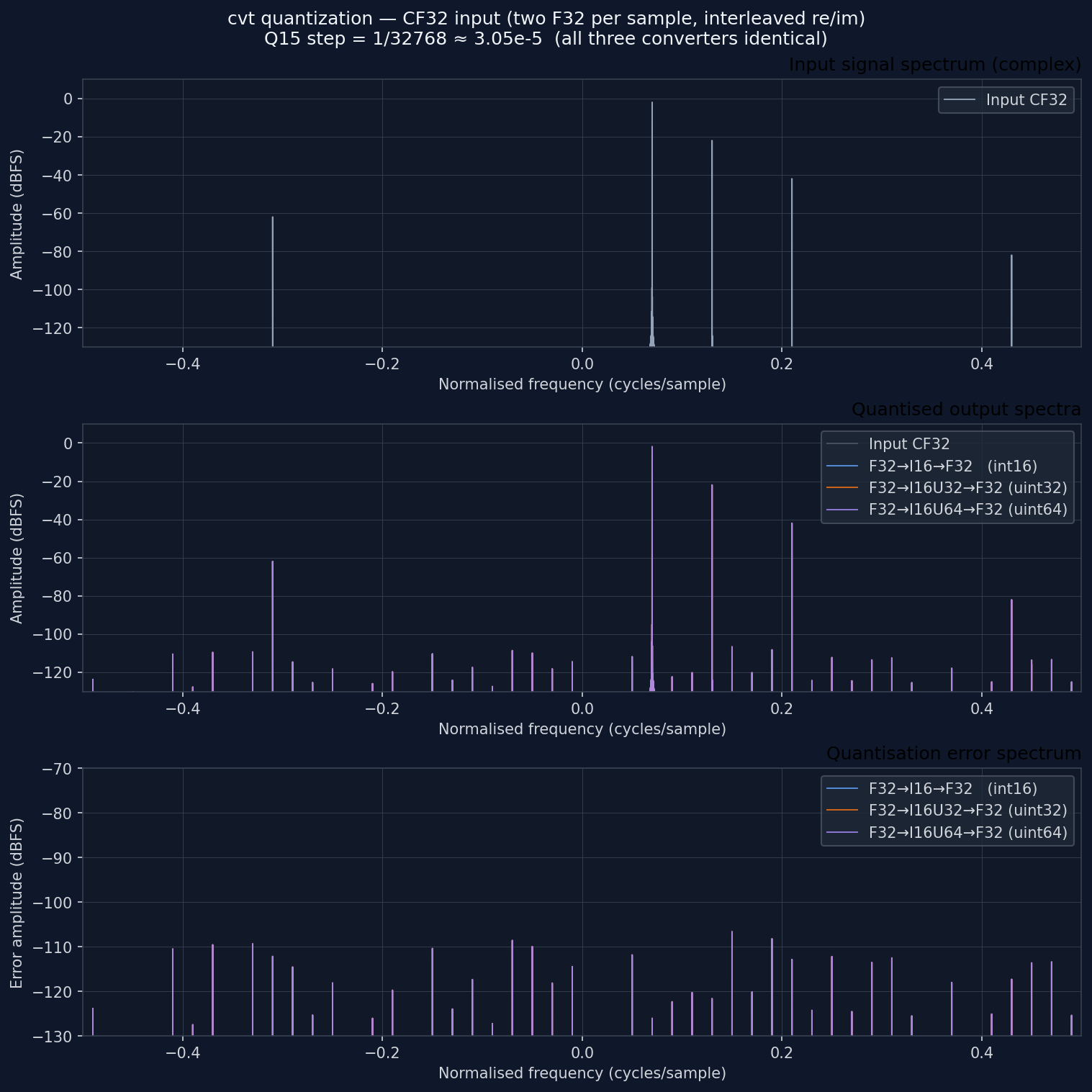
What you're seeing
A multi-tone CF32 signal spanning 80 dB of dynamic range is passed through
all three doppler.cvt encoder/decoder pairs and the results are compared.
Top — Input signal. Five complex tones at 0, −20, −40, −60, and −80 dBFS. The −60 dBFS tone is at a negative frequency (−0.31 cycles/sample) and only visible in the full complex spectrum.
Middle — Quantised output (overlaid). All three converters (I16, I16U32, I16U64) are plotted. The traces are identical: every converter uses the same Q15 quantization step (Δ = 2⁻¹⁵ ≈ 3.05 × 10⁻⁵), so the quantization noise floor is the same regardless of the container width. The −80 dBFS tone sits right at the Q15 noise floor (~−92 dBFS).
Bottom — Quantisation error spectrum. xq − x for each converter.
White quantization noise floor at ~−92 dBFS confirms Q15 SNR theory.
The tones themselves are absent from the error spectrum — only
quantization noise remains.
The three cvt formats
| Format | Container | Q15 bits | Extra bits | Use |
|---|---|---|---|---|
F32ToI16 / I16ToF32 |
int16_t |
15+sign | — | Audio, signed buffers |
F32ToI16U32 / I16U32ToF32 |
uint32_t |
15+sign in bits 15:0 | 16 zero | Legacy 32-bit pipelines |
F32ToI16U64 / I16U64ToF32 |
uint64_t |
15+sign in bits 15:0 | 48 zero | CIC integrator input |
All three carry the same Q15 bit pattern — the container width determines
downstream integer headroom, not quantization error. The CIC decimator
consumes I16U64 directly: the 48 upper bits absorb up to N·log₂(R) = 48
bits of pipeline gain before overflow.
The encoders expose a sticky .clipped property that reads True if any
sample has been saturated since the last reset():
from doppler.cvt import F32ToI16, I16ToF32
import numpy as np

# Encode float32 → int16 (Q15)
enc = F32ToI16()
x = np.array([0.5, 0.8, -0.3, -0.9], dtype=np.float32)
q = enc.steps(x)                   # q.dtype == int16
print(enc.clipped)                  # False — all values within (-1, 1)

# Decode int16 → float32
dec = I16ToF32()
x_hat = dec.steps(q)               # x_hat.dtype == float32
print(np.max(np.abs(x - x_hat)))   # ~1.5e-5 (Q15 step size)

# sticky clipped flag
enc2 = F32ToI16()
enc2.steps(np.array([0.5, 1.2, -0.3], dtype=np.float32))
print(enc2.clipped)                 # True — 1.2 exceeded full scale
enc2.reset()
print(enc2.clipped)                 # False
See docs/design/QUANTIZATION.md for the
full storage-format specification and headroom budget analysis.